Amid intensifying global competition to attract foreign direct investment (FDI), Vietnam is progressively refining its legal and policy framework to enhance the attractiveness of its investment environment while creating more favorable conditions for foreign investors entering the market. Whereas previous policies primarily focused on attracting capital inflows, generating employment, and promoting rapid economic growth, Vietnam’s strategic orientation has increasingly shifted toward a model of “selective investment attraction,” prioritizing projects that deliver high added value, technological spillover effects, strong governance capabilities, and sustainable contributions to the national economy.
In this context, the promulgation of the 2025 Law on Investment (Law No. 143/2025/QH15), effective from March 1, 2026, together with Decree No. 96/2026/ND-CP, marks a significant development in Vietnam’s efforts to further its investment legal framework. For foreign investors, these legal and regulatory changes not only create broader opportunities for business expansion and market access but also impose higher expectations regarding regulatory compliance, market entry conditions, and the ability to adapt to an increasingly sophisticated legal environment.
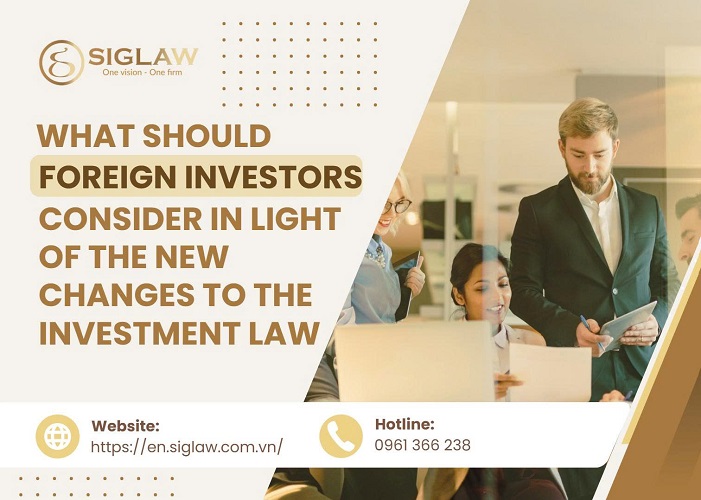
Accordingly, in light of the amendments introduced under the new Investment Law, what key considerations should foreign investors take into account to mitigate legal risks and optimize business opportunities in Vietnam? In the following article, Siglaw Firm provides an overview of the key issues and practical considerations that foreign investors should pay close attention to in response to the evolving investment legal framework in Vietnam.
Key Considerations Regarding Changes in the Procedure for Establishing an Economic Organization: Faster Opportunities but Greater Legal Responsibility
One of the most notable changes introduced under the new Investment Law is the adjustment to the investment procedure applicable to foreign investors establishing an economic organization in Vietnam.
Previously, under the traditional regulatory framework, most foreign investors were required to undergo a relatively lengthy process. Specifically, investors had to first obtain an Investment Registration Certificate (IRC) before proceeding with the incorporation of an enterprise to obtain an Enterprise Registration Certificate (ERC). While this sequence enabled regulatory authorities to maintain stronger oversight and risk control, in practice, it often prolonged project implementation timelines, particularly for conditional business sectors or industries requiring multiple sub-licenses and regulatory approvals.
Under the new reform-oriented approach, investment procedures are becoming more flexible with the objective of reducing time-related compliance costs for businesses. This shift offers significant advantages, as investors may now prepare operational activities more efficiently, including opening bank accounts, entering into office lease agreements, recruiting personnel, and establishing operational structures during the early stages of market entry.
However, the benefits of expedited procedures also come with increased legal risks. As the regulatory framework moves toward a more facilitative approach, the responsibility for independently assessing the legal feasibility and compliance of investment projects prior to implementation increasingly falls upon investors themselves. If investors incorrectly select business lines, inaccurately assess market access conditions, or fail to comprehensively review applicable investment requirements, businesses may face repeated amendments to application dossiers, project delays, or even legal disputes at a later stage.
Example: A logistics investor from Singapore establishes a company in Vietnam to provide warehousing and cross-border transportation services. If the investor merely categorizes the business as a general logistics service without carefully reviewing the sub-sectors subject to foreign market access conditions, the enterprise may encounter substantial difficulties relating to foreign ownership limitations, licensing requirements, or restrictions on the scope of permitted business operations.
Accordingly, this regulatory change may be viewed as a “double-edged sword”: while procedures become faster and more streamlined, the legal responsibility borne by investors increases significantly. This development underscores the importance of conducting thorough investment legal due diligence from the earliest stages of project preparation and application planning.
Market Access Conditions Are Shifting from “Broad Liberalization” to “Selective Opening”
Another important consideration for foreign investors lies in Vietnam’s evolving approach to market access. While previous FDI attraction policies largely emphasized broad market liberalization and investment incentives to maximize capital inflows, the current trend is gradually shifting toward a more selective approach, prioritizing high-quality investment projects that align with the country’s long-term development strategies.
This development means that sectors involving data, digital infrastructure, core technologies, logistics, fintech, artificial intelligence (AI), energy, environmental services, or other industries considered sensitive to economic security may become subject to more stringent scrutiny concerning market access conditions, financial capacity, and the broader socio-economic impact of investment projects.
From a positive perspective, this approach enables Vietnam to improve the quality of incoming FDI by discouraging low-technology, environmentally harmful, or labor-intensive projects that generate limited added value for the economy. At the same time, it creates greater opportunities for investors possessing advanced technologies, strong governance capabilities, and long-term investment commitments.
On the other hand, a more selective screening process also requires investors to incur greater preparation costs and provide more comprehensive explanations regarding their business models, technologies, and the environmental and social implications of their projects.
For example, a Korean technology company seeking to establish a data center in Vietnam would no longer focus solely on standard investment procedures. Instead, it would also need to simultaneously consider regulations concerning cybersecurity, data governance, environmental standards, and market access conditions applicable to digital infrastructure sectors. This represents a significant departure from previous periods, when approval criteria were primarily centered on investment capital and implementation capability.
Accordingly, in response to these regulatory developments, foreign investors are advised to proactively prepare relevant information from the earliest stages of project planning and develop robust investment dossiers supported by clear justifications regarding economic efficiency, technological contributions, and sustainable development impacts. Such preparation will not only improve market entry prospects but also help mitigate potential legal and regulatory risks.
A Significant Shift from Ex-Ante Control to Ex-Post Supervision: Faster Procedures but Higher Compliance Risks
One of the most significant developments affecting foreign investors in the new regulatory landscape is Vietnam’s evolving investment management approach, transitioning from a heavily ex-ante approval model toward a framework emphasizing ex-post supervision and risk-based governance throughout project implementation and operation.
For many years, the ex-ante control mechanism has served as the prevailing regulatory approach for foreign investment activities in Vietnam. Under this model, investors were generally required to undergo extensive scrutiny before project implementation, including assessments of financial capacity, investment objectives, project location, environmental impact, market access conditions, and various licensing requirements. The principal advantage of this approach lay in its ability to mitigate risks at an early stage and prevent underqualified or unsuitable projects from obtaining approval.
However, the drawbacks of this system have also been evident. Lengthy processing periods, high compliance costs, and procedural complexities have at times reduced business opportunities for investors, particularly in rapidly evolving markets. This has also been one of the key drivers behind Vietnam’s investment reform efforts aimed at enhancing competitiveness with other jurisdictions in the region.
Under the new regulatory direction, Vietnam is gradually shifting toward an ex-post supervision model, whereby barriers to market entry are reduced while oversight during business operations is significantly strengthened. In practice, this means that enterprises may be able to commence projects more quickly, but they will simultaneously face more stringent compliance expectations once operations begin.
From a positive perspective, this approach allows investors to substantially reduce market entry costs and shorten project implementation timelines. Businesses operating transparently and supported by strong internal compliance systems are likely to benefit significantly from streamlined administrative procedures and accelerated project execution.
Nevertheless, a key concern lies in the increased compliance risks after market entry. If enterprises underestimate or fail to comply with legal obligations relating to land use, environmental protection, construction regulations, sector-specific licensing conditions, or investment reporting requirements, the consequences of ex-post inspections may be considerable. In an environment where sectoral inspections are becoming increasingly digitalized and interconnected through data-sharing systems, the likelihood of regulatory violations being identified has become substantially higher than in the past.
Accordingly, rather than focusing solely on obtaining approvals as quickly as possible, foreign investors should adopt a broader strategic perspective centered on “fast investment with sustainable compliance.” This requires establishing robust internal compliance mechanisms from the outset to ensure long-term operational stability and minimize legal exposure.
Investment Incentive Mechanisms Are Evolving: No Longer Primarily Tax-Based
Another significant development that foreign investors should pay close attention to is the transformation of Vietnam’s investment incentive framework, particularly under the influence of the 15% Global Minimum Tax policy.
In previous periods, Vietnam’s investment incentives were largely centered on corporate income tax exemptions and reductions, land rental incentives, and import duty exemptions for machinery and equipment. These measures historically served as an important competitive advantage, enabling Vietnam to attract substantial FDI inflows, particularly in the manufacturing and processing sectors.
However, as major economies increasingly adopt the Global Minimum Tax regime, the effectiveness of tax-based competition is gradually diminishing. Even where enterprises benefit from preferential tax rates in Vietnam, jurisdictions in which parent companies are headquartered may still impose a top-up tax to ensure the effective tax rate reaches the minimum threshold of 15%. As a result, traditional tax incentives may no longer provide the same competitive advantage as they once did.
This shift is compelling Vietnam to reconsider its investment attraction strategy, moving from a model of “broad tax incentives” toward a framework of “targeted investment support.” Rather than relying solely on tax reductions or exemptions, emerging policies increasingly emphasize more substantive forms of support, including infrastructure development, research and development (R&D) assistance, workforce training, technology innovation support, and the establishment of industrial support ecosystems.
From a positive perspective, this approach helps attract strategic investors with long-term commitments, rather than projects driven primarily by short-term tax benefits. At the same time, it contributes to improving the overall quality of FDI inflows, aligning with Vietnam’s long-term objectives of promoting high technology, sustainable development, and a green economy.
On the other hand, a more selective incentive mechanism is often accompanied by higher qualification standards. Enterprises operating in low-technology sectors, generating limited added value, or lacking meaningful technology transfer capacity may find it increasingly difficult to access the same level of incentives previously available under Vietnam’s investment regime.
ESG and Supply Chain Responsibility Are Becoming De Facto “Soft Requirements”
One emerging issue that many foreign investors tend to underestimate, yet is becoming increasingly significant in practice, is compliance with ESG (Environmental, Social, and Governance) standards.
Although ESG requirements are not always legally mandatory in the traditional sense, they are progressively evolving into de facto “soft requirements” that significantly influence market access, investment incentives, and participation in global supply chains.
This development stems from the fact that major markets such as the European Union, the United States, Japan, and South Korea are increasingly imposing stricter standards relating to carbon emissions, traceability of raw materials, sustainable labor practices, and corporate responsibility throughout supply chains.
From a positive perspective, ESG compliance enhances corporate reputation, improves access to international financing, and facilitates participation in the supply chains of multinational corporations. Conversely, these requirements may also substantially increase initial investment costs, particularly in sectors such as manufacturing, energy, and infrastructure.
In practice, many Vietnamese enterprises participating in the supply chains of major multinational corporations such as Samsung and Apple are already required to comply with stringent standards concerning emissions control, occupational safety, and internal governance systems. Foreign investors entering the Vietnamese market in the future will likely face similar expectations if they seek to maintain long-term competitiveness and integration into global value chains.
Legal Risks During the Transitional Period: A Factor Investors Should Not Underestimate
Any significant legal reform is inevitably accompanied by a transitional period characterized by interpretative uncertainties and implementation challenges. The new Investment Law is no exception.
During the early stages of implementation, investors may encounter practical difficulties, including inconsistent interpretations among local authorities, procedural adjustments in investment licensing processes, and a lack of synchronization between the Investment Law and related legal frameworks governing land, construction, environmental compliance, and conditional business sectors.
On the positive side, investors entering the market early may benefit from significant commercial opportunities and first-mover advantages. However, the corresponding risks are also greater, particularly where enterprises fail to stay updated on legal developments or adopt investment structures that are not fully aligned with the evolving regulatory framework.
Accordingly, prior to commencing projects in Vietnam, foreign investors are strongly advised to undertake a comprehensive legal review, including assessments of market access conditions, investment structures, available incentives, and long-term compliance strategies, rather than focusing solely on the initial procedures for company establishment.
Practical Recommendations for Foreign Investors
In light of the changes introduced under the new Investment Law, foreign investors should avoid approaching the Vietnamese market with the outdated mindset of “obtaining licenses first and addressing compliance issues later.” Instead, investors are encouraged to adopt an investment strategy grounded in risk management and legal compliance from the earliest stages of project preparation.
Businesses should conduct legal due diligence prior to investment, carefully review market access conditions applicable to their intended business sectors, assess eligibility for investment incentives, and establish ESG frameworks and internal compliance systems from the outset. At the same time, investors should proactively monitor implementing regulations and practical guidance issued during the initial enforcement period of the new law.
Based on its experience advising numerous FDI projects in Vietnam, Siglaw Firm recommends that investors engage legal counsel from the pre-investment stage in order to minimize legal risks, maximize eligibility for available incentives, and ensure the smooth and efficient implementation of investment projects.
It can be seen that the changes introduced under the new Investment Law are not merely technical legal amendments but also reflect a broader transformation in Vietnam’s investment governance philosophy. Specifically, the country is transitioning from prioritizing investment quantity to emphasizing investment quality, from broad-based incentives to targeted support mechanisms, and from extensive ex-ante control to strengthened ex-post supervision.
Against the backdrop of a rapidly evolving investment environment, foreign investors should not focus solely on the likelihood of obtaining investment approval. Rather, they should proactively undertake a comprehensive assessment of the legal feasibility, commercial viability, and alignment of their projects with Vietnam’s evolving FDI attraction strategy. Thorough preparation in relation to investment structure, business sectors, regulatory requirements, and long-term compliance strategies will enable enterprises to mitigate risks, optimize costs, and strengthen long-term operational stability.
With extensive experience advising foreign-invested projects in Vietnam, Siglaw Firm stands ready to support investors in reviewing investment conditions, assessing project feasibility, structuring appropriate investment models, and facilitating investment procedures in compliance with prevailing legal regulations.
Investors and enterprises seeking consultation regarding FDI policies, legal due diligence for investment projects, establishment of foreign-invested companies, or assistance with investment procedures under the latest legal framework are welcome to contact Siglaw Firm for further guidance and support:
Headquarters in Hanoi City: No. 44/A32 -– NV13, Area A Geleximco, Le Trong Tan Street, Tay Mo Ward, Hanoi City.
Branch in the South: No. 103 – 105, Nguyen Dinh Chieu Street, Xuan Hoa Ward, Ho Chi Minh.
Branch in the Central Region: VIFC DN – ICT Building Software Park No. 2, Nhu Nguyet Street, Hai Chau Ward, Da Nang City
Email: vp@siglaw.com.vn
Hotline: 0961 366 238
Facebook: https://www.facebook.com/hangluatSiglaw