In the context of increasingly deep international integration, the need to use legal documents between countries is becoming more common, especially in investment, business, education, and residency activities. However, the traditional consular legalization process with many procedural steps has caused many difficulties, prolonging processing time and incurring costs for individuals and organizations needing to use foreign documents in Vietnam.
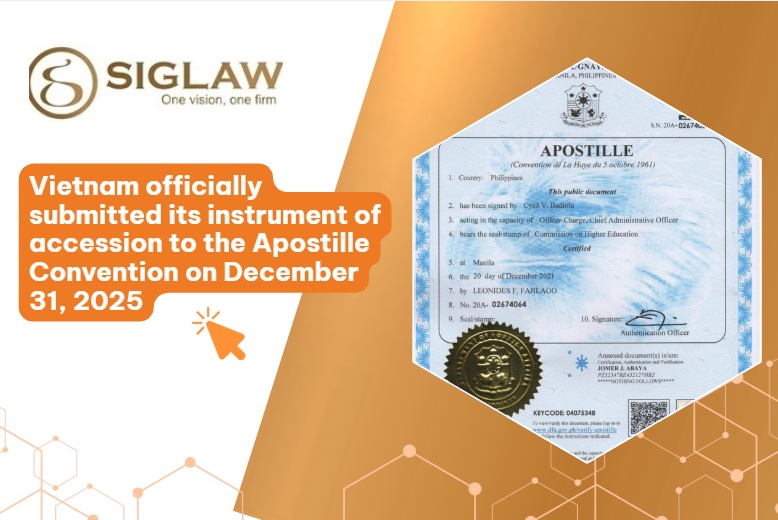
To simplify the recognition of public documents between countries, the Hague Convention on the Exemption from Legalization Requirements for Foreign Public Documents (Apostille Convention) established the Apostille certification mechanism – allowing documents issued in one member state to be used in another member state with only a single certification. Vietnam officially submitted its instrument of accession to the Apostille Convention on December 31, 2025, and the Convention is expected to enter into force in Vietnam on September 11, 2026, marking a significant step forward in administrative procedure reform and international legal integration.
In the article below, SIGLAW will provide detailed information about the Apostille Convention, the changes compared to the current consular legalization procedure, its scope of application, and its important impacts on investment and business activities in Vietnam.
What is the Apostille Convention?
The Apostille Convention (full name: Hague Convention Abolishing the Requirement of Legalisation for Foreign Public Documents) is an international treaty adopted within the framework of the Hague Conference on Private International Law (HCCH) to simplify the procedures for recognizing and using public documents between member states.
Before the Apostille mechanism, using documents issued by competent authorities of one country in another country typically required a multi-step consular legalization process, including confirmation by competent authorities in the issuing country and legalization at the diplomatic mission of the country where the document was to be used. This process was often time-consuming, costly, and created administrative barriers for individuals and organizations needing to conduct cross-border transactions.
The core objective of the Apostille Convention is to simplify the procedures for recognizing public documents between countries, facilitating the flow of documents in international civil, commercial, and administrative relations.
Through a unified certification mechanism, the Convention aims to:
- Minimize unnecessary administrative procedures in the use of foreign documents;
- Shorten the processing time for cross-border applications;
- Reduce compliance costs for individuals, businesses, and investors;
- Increase transparency, convenience, and predictability in the recognition of documents between countries.
Scope of Application of the Apostille Convention
The Apostille Convention applies to public documents issued in one Member State and used in another Member State. When a document meets the requirements of the Convention and is certified Apostille by a competent authority, it will, in principle, be recognized by the receiving Member State without requiring further consular legalization procedures.
Common categories of documents covered by the Convention include:
- Documents issued by judicial authorities;
- Administrative documents;
- Notarized documents;
- Official certifications attached to private documents;
- Business records, power of attorney, legal documents of parent companies;
- Academic records, diplomas and documents for personal purposes.
However, the Convention does not apply to certain types of documents, including those issued by diplomatic or consular agencies and administrative documents directly related to trade or customs activities.
Vietnam Joins the Apostille Convention
Vietnam’s accession to the Apostille Convention marks a significant step forward in the process of administrative procedure reform and integration with international legal standards. Vietnam submitted its instrument of accession to the Apostille Convention on December 31, 2025. According to the plan, the Convention is expected to enter into force in Vietnam on September 11, 2026.
When the Apostille mechanism is officially implemented, individuals, businesses, and foreign investors in Vietnam will have a more convenient way to use foreign documents, contributing to reduced administrative costs, shorter processing times, and promoting cross-border trade and investment activities.
Current Status of Consular Legalization Procedures in Vietnam
What is Consular Legalization?
Consular legalization is a procedure carried out by competent authorities in Vietnam to certify the seal, signature, and title on documents issued by foreign agencies or organizations so that those documents are recognized and legally used in Vietnam.
Essentially, consular legalization does not aim to confirm whether the content of the document is correct or incorrect, but only to confirm the formal validity of the document, including confirming the signatory, the title of the signatory, and the seal of the foreign agency or organization that issued or certified the document.
Current Consular Legalization Procedure
According to the current common procedure, for a document issued abroad to be usable in Vietnam, individuals or organizations usually have to follow these steps:
Step 1: Notarization or authentication in the issuing country
First, the document needs to be validated in the country where it was issued. Depending on the type of document and the legal regulations of each country, this step may include notarization, authentication, or confirmation by a competent authority.
Step 2: Certification by a diplomatic mission or competent authority of the issuing country
After notarization or authentication, the document is then sent to the competent authority in the issuing country to confirm the signature, seal, or status of the agency or person who issued the document.
Step 3: Legalization at a Vietnamese Diplomatic Mission
Finally, the document must be legalized at the Embassy, Consulate General, or competent diplomatic mission of Vietnam in the country where the document was issued before it can be used in Vietnam.
Thus, the traditional consular legalization process usually involves several consecutive layers of verification, which can be summarized in the following order:
Notarization/Authentication → Certification by the competent authority of the issuing country → Legalization at the Vietnamese Embassy/Consulate.
Limitations of the Current Consular Legalization Procedure
Although consular legalization plays a crucial role in ensuring the legal validity of foreign documents, this process still has certain limitations.
First, the procedure involves many intermediate steps.
Those needing the documents must contact various agencies in both the issuing country and Vietnam. This increases the complexity of the application process, especially for individuals and businesses with little experience in international procedures.
Second, the processing time is lengthy.
Due to the numerous verification stages, the consular legalization procedure can take weeks to complete, affecting the progress of related tasks such as business establishment, investment license applications, contract signing, or the completion of legal documents.
Overall, the current consular legalization process can cause delays in market entry, licensing, or conducting business transactions in Vietnam.
Third, it increases compliance costs.
In addition to direct administrative costs, individuals and businesses may also have to pay additional fees related to notarization, translation, document transportation, or the use of procedural support services.
Fourth, it hinders international investment and business activities.
For foreign investors, having to complete many steps in legalizing documents can prolong the time required to prepare investment dossiers, establish businesses, or carry out legal procedures in Vietnam. This is one of the factors affecting the favorable investment environment and the ability to quickly implement projects with foreign elements.
These limitations are the basis for Vietnam’s participation in the Apostille Convention, aiming to simplify the procedures for recognizing foreign documents, reduce administrative burdens, and facilitate cross-border transactions in the future.
How does Apostille change the procedure for recognizing documents?
Apostille – A certificate replacing many procedures
The introduction of the Apostille mechanism has created a significant change in the method of recognizing public documents between countries. Instead of having to go through the consular legalization process with many consecutive verification steps, those who need to use foreign documents only need to apply for an Apostille certificate at the competent authority of the country where the document was issued.
The Apostille certificate serves to confirm the authenticity of the signature, the capacity of the signatory, and the seal on the public document, helping that document to be recognized for use in other member states of the Convention without the need for additional consular legalization procedures at diplomatic missions.
Under this mechanism, after a document is issued an Apostille by the competent authority of the issuing country, the receiving country will not require any additional consular certification steps. This eliminates the multi-tiered verification process, creating a simpler, more unified, and more efficient recognition mechanism among member states.
Comparison of current and post-Apostille procedures
Before the implementation of the Apostille mechanism, foreign documents used in Vietnam typically had to go through several consecutive verification steps. The person performing the procedure had to complete notarization/authentication, obtain confirmation from the competent authority in the issuing country, and then proceed with legalization at a Vietnamese diplomatic representative office.
The current process can be described as follows:
Notarization/authentication → Certification by the competent authority of the issuing country → Legalization at the Vietnamese Embassy/Consulate.
Meanwhile, under the Apostille mechanism, the procedure is significantly simplified:
Notarization/authentication → Obtain Apostille certification from the competent authority of the issuing country.
Thus, the biggest difference of the Apostille mechanism is the shift from a multi-level verification model to a single-step certification model. This change not only helps reduce administrative procedures but also contributes to improving the efficiency of processing documents with foreign elements, supporting investment, business activities, and civil exchanges between Vietnam and member states of the Convention.
Impact of the Apostille Convention on Foreign Businesses and Investors
Vietnam’s participation in the Apostille Convention is expected to bring about positive changes in the recognition and use of foreign documents, especially for international businesses, investors, and individuals whose activities involve multiple countries. The new mechanism not only contributes to simplifying administrative procedures but also supports the promotion of a cross-border investment and business environment in Vietnam.
For Foreign Businesses
For foreign businesses wishing to invest, establish, and operate in Vietnam, the Apostille mechanism offers many practical benefits in the process of preparing and using legal documents.
Firstly, shortening the time for preparing investment documents:
Previously, foreign business documents such as business registration certificates, company charters, appointment decisions, power of attorney, or parent company documents often had to go through many consular legalization steps before being used in Vietnam. The application of Apostille reduces these intermediate steps, thereby shortening the time required to complete investment applications.
Secondly, simplifying business establishment procedures:
For foreign investors establishing economic organizations in Vietnam, using business documents already issued with Apostille makes the process of proving the investor’s legal status easier. This contributes to speeding up procedures related to investment registration, business registration, and other legal procedures.
Third, reduced costs for legalizing documents
Eliminating the consular legalization step at diplomatic missions helps businesses reduce costs related to notarization, certification, document processing, and the time and personnel spent on completing procedures.
Fourth, support for cross-border transactions
The Apostille mechanism facilitates businesses in using legal documents across multiple countries, thereby supporting contract signing, authorization, market expansion, and international trade transactions.
For International Investors
For foreign investors, simplifying the document recognition procedures is crucial in enhancing the convenience and accessibility of the Vietnamese market.
Some notable impacts include:
First, faster document recognition
Documents issued by Apostille in member countries will be recognized in Vietnam without requiring additional consular legalization, helping investors quickly complete the necessary documentation for investment activities.
Second, reduced legal compliance costs
Investors can save on costs incurred during the document legalization process, while also reducing the time spent monitoring and processing administrative procedures.
Third, shortened licensing and approval times
Simplifying legal documents can contribute to speeding up the implementation of procedures such as applying for investment registration certificates, establishing businesses, or implementing investment projects in Vietnam.
Fourth, enhancing transparency and predictability in legal procedures
The application of a unified certification mechanism among member states makes it easier for investors to predict documentation requirements, prepare appropriate documents, and reduce uncertainty in cross-border procedures.
For foreign individuals in Vietnam
The Apostille Convention not only impacts business operations but also facilitates foreign individuals in living, studying, and working in Vietnam.
Some areas that benefit include:
- Education: Easier use of degrees, transcripts, and training certificates from abroad for admission, recognition of qualifications, or other educational procedures.
- Employment: Support for foreign workers in using personal documents and professional papers in job applications, work permits, or related procedures.
- Marriage and family relations: Simplify the use of civil registration and personal identification documents in marriage registration procedures or resolving family matters involving foreign nationals.
- Administrative procedures: Reduce difficulties for foreign individuals needing to use documents issued by foreign authorities in Vietnam.
Some Shortcomings and Limitations in the Application of the Apostille Convention
Although the Apostille Convention offers many benefits in simplifying document recognition procedures, its practical implementation may still encounter some difficulties and limitations.
First, the requirement to accurately determine the scope of application
Not all types of foreign documents fall within the scope of the Apostille Convention. Some documents, such as those issued by diplomatic missions, consulates, or administrative documents directly related to trade and customs, may still be subject to separate procedures.
This requires individuals and businesses to accurately identify the type of document before proceeding with the procedure to avoid wasting time or incurring unnecessary costs.
Second, time is needed to perfect the domestic implementation mechanism
Joining the Apostille Convention is only the first step; To implement it effectively, Vietnam needs to continue improving its guiding regulations, identifying the competent authority for issuing certificates, the acceptance process, and the coordination mechanism between relevant agencies.
Third, differences in laws and management systems between countries
Although Apostille creates a unified certification mechanism, each member country still has its own regulations regarding the issuance of notarized documents, the management of seals and signatures, and the authority to certify. This may cause some difficulties in checking and verifying the validity of documents in some special cases.
Fourth, awareness and accessibility of the new process
Businesses and individuals may need time to familiarize themselves with the Apostille mechanism, especially during the initial implementation phase. Lack of information or understanding of the new process may lead to the preparation of inappropriate documents.
Overall, although some challenges remain in the implementation process, the Apostille Convention is considered a significant step forward in administrative procedure reform, contributing to reducing the compliance burden and enhancing the facilitation of international investment and business activities in Vietnam.
What is the significance of the Apostille Convention for Vietnam’s investment environment?
Vietnam’s accession to the Apostille Convention not only creates a change in the mechanism for recognizing foreign documents but also has significant implications for improving the investment and business environment as well as international economic integration. This mechanism contributes to minimizing administrative barriers, enhancing the facilitation of cross-border transactions, and strengthening the confidence of foreign investors in Vietnam’s legal system.
In particular, for multinational corporations needing to establish subsidiaries, expand business operations, or conduct transactions in Vietnam, reducing administrative procedures will contribute to shortening project implementation time and improving investment efficiency. The Apostille Convention is expected to support the investment environment by reducing administrative burdens and promoting cross-border transactions.
Overall, the Apostille Convention contributes to building a more interconnected business environment between Vietnam and the international community. This is one of the important factors helping Vietnam continue to attract high-quality foreign investment, promote international trade, and enhance the competitiveness of the economy.
The introduction of the Apostille Convention marks a significant step forward in Vietnam’s administrative reform and international legal integration. Replacing the multi-step consular legalization process with the Apostille certification mechanism not only simplifies the recognition of foreign documents but also facilitates cross-border activities for individuals, businesses, and investors.
However, in the initial stages of implementation, correctly identifying the scope of documents to which Apostille applies, preparing appropriate documentation, and following the correct procedures may still pose difficulties for individuals and organizations without a thorough understanding of the relevant legal regulations.
With a team of experienced professionals in corporate law and international legal procedures, SIGLAW provides comprehensive consulting and support services related to Apostille and document legalization in Vietnam, including advice on determining the type of documents requiring Apostille or consular legalization, assistance in preparing documents, representation in procedures with competent authorities, and advice on the use of foreign documents in Vietnam.
SIGLAW FIRM is committed to accompanying clients throughout the process of handling cross-border legal procedures, helping businesses and individuals save time and costs, while ensuring that documents are prepared correctly and appropriately for their intended use.
Head Office in Hanoi: 44/A32 – NV13, Geleximco Area A, Le Trong Tan Street, Tay Mo Ward, Hanoi City.
Southern Branch: 103-105 Nguyen Dinh Chieu Street, Xuan Hoa Ward, Ho Chi Minh City.
Central Branch: VIFC DN – ICT Building, Software Park No. 2, Nhu Nguyet Street, Hai Chau Ward, Da Nang
Email: vp@siglaw.com.vn
Hotline: (+84)961 366 238
Facebook: https://www.facebook.com/hangluatSiglaw