In the context of Vietnam’s continued efforts to promote administrative reform and improve the investment and business environment, on 18 May 2026, the Government issued Resolution No. 66.18/2026/NQ-CP on decentralization, reduction, and simplification of administrative procedures and business conditions.
One of the most notable changes introduced under this Resolution is the significant increase in the economic concentration notification thresholds under Vietnamese competition law, which is expected to take effect from 1 July 2026.
Economic Concentration Notification Thresholds Significantly Increased
Under the current Vietnamese competition law framework, enterprises participating in M&A transactions are required to notify the National Competition Commission if any of the statutory thresholds relating to assets, revenue, transaction value, or combined market share are met.
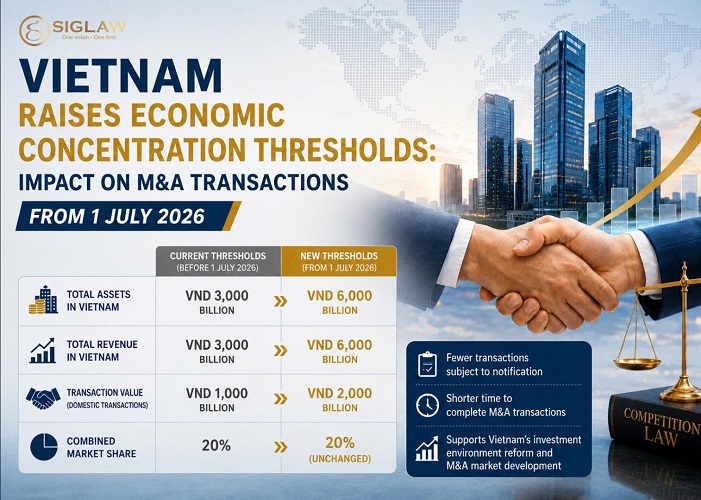
The new Resolution substantially increases the financial thresholds as follows:
- The threshold for total assets in Vietnam of the participating enterprises increases from VND 3 trillion to VND 6 trillion;
- The threshold for total revenue in Vietnam increases from VND 3 trillion to VND 6 trillion;
- The transaction value threshold for domestic transactions increases from VND 1 trillion to VND 2 trillion;
- The combined market share threshold remains unchanged at 20%.
Accordingly, the principal financial thresholds have effectively doubled compared to the previous regulations.
Significance of the Increase in Economic Concentration Thresholds
Reduction in the Number of Transactions Subject to Notification
The increase in financial thresholds is expected to significantly reduce the number of M&A transactions subject to mandatory economic concentration notification procedures.
In practice, many medium-sized transactions previously had to undergo relatively lengthy competition review procedures, resulting in increased transaction costs and execution timelines.
This adjustment is therefore expected to facilitate investment, mergers, and acquisitions activities, particularly for transactions with limited anti-competitive impact.
Shorter M&A Transaction Timelines
Currently, economic concentration notification procedures often constitute one of the conditions precedent in M&A transactions. The requirement to wait for review and approval from the competition authority may significantly affect transaction closing timelines.
With the higher notification thresholds, many transactions will no longer fall within the mandatory notification regime, thereby enabling parties to complete transactions more quickly and reduce legal risks during implementation.
Reflecting Vietnam’s Ongoing Investment Environment Reform
This development reflects the Government’s policy direction toward balancing competition law enforcement objectives with the need to promote investment and business activities.
The reduction of administrative burdens is viewed as a positive signal for the business community and investors, particularly as Vietnam continues to attract high-quality foreign investment and further develop its M&A market.
Businesses Should Still Be Aware of Legal Risks
Although the financial thresholds have been increased, businesses should note that the obligation to notify an economic concentration may still arise if any one of the statutory criteria is satisfied, including the combined market share threshold.
In addition, the assessment of notification obligations is not based solely on transaction value but may also involve consideration of group structure, consolidated revenue, consolidated assets, and the relevant market.
In many cases, determining whether a transaction falls within the notification regime requires in-depth legal and competition-economic analysis.
Accordingly, enterprises and investors involved in M&A transactions should continue conducting competition law assessments at the transaction structuring stage in order to avoid potential violations relating to merger control regulations.
Conclusion
The increase in economic concentration thresholds effective from 1 July 2026 represents a significant development in Vietnam’s competition law policy, contributing to the reduction of administrative procedures and facilitating M&A activities.
Nevertheless, businesses should remain cautious when assessing notification obligations and competition-related risks, particularly in transactions involving large transaction values or those potentially affecting market structure.
Siglaw Firm will continue monitoring and updating the latest developments in Vietnamese competition law and M&A activities in order to support enterprises and investors throughout the transaction process.
Contact Us:
Headquarters in Hanoi: No. 44/A32 – NV13, Geleximco Area A, Le Trong Tan Street, Tay Mo Ward, Hanoi, Vietnam.
Southern Branch: No. 103 – 105 Nguyen Dinh Chieu Street, Xuan Hoa Ward, Ho Chi Minh City, Vietnam.
Central Branch: VIFC DN – ICT Building, Software Park No. 2, Nhu Nguyet Street, Hai Chau Ward, Da Nang, Vietnam.
Hotline: 0961 366 238
Facebook: https://www.facebook.com/hangluatSiglaw