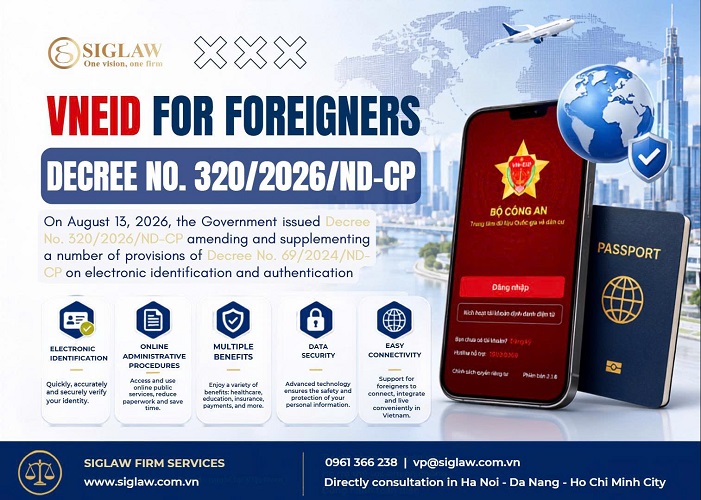
On August 13, 2026, the Government issued Decree No. 320/2026/ND-CP amending and supplementing a number of provisions of Decree No. 69/2024/ND-CP on electronic identification and authentication. Decree No. 320/2026/ND-CP will take effect from September 28, 2026, introducing several notable changes concerning the issuance and use of electronic identification accounts by foreigners in Vietnam.
The new regulations significantly expand the scope of foreigners eligible to obtain electronic identification accounts while introducing additional features available on the National Identification Application (VNeID). This article by Siglaw Firm provides an overview of the key changes that are expected to apply in the near future.
Expanded eligibility for foreigners to obtain VNeID accounts
One of the most notable changes under Decree No. 320/2026/ND-CP is the expansion of foreigners eligible to obtain electronic identification accounts. Under Clause 2, Article 7 of Decree No. 69/2024/ND-CP, foreigners aged six or older were previously eligible for a Level 1 or Level 2 electronic identification account only if they had been issued a permanent residence card or temporary residence card in Vietnam. Foreigners under six years of age holding a permanent or temporary residence card could obtain a Level 1 account upon request.
This provision has been amended under Clause 2, Article 3 of Decree No. 320/2026/ND-CP. Accordingly, foreigners who legally enter or legally reside in Vietnam may be issued an electronic identification account upon request, regardless of the account level. Therefore, the previous requirement of holding a permanent or temporary residence card is no longer imposed as a condition for eligibility.
In addition, Decree No. 320/2026/ND-CP further clarifies the value and scope of use of electronic identification accounts for foreigners. Under Clause 3, Article 5, an electronic identification account may be used to access and retrieve electronic identity information and other information shared, integrated, or updated from national databases and specialized databases, as well as to use the features, utilities, and applications of the electronic identification and authentication system and connected information systems in accordance with law.
New communication channel on the VNeID application
Under Clause 10, Article 5 of Decree No. 320/2026/ND-CP, foreigners with electronic identification accounts will be provided with a communication channel on the National Identification Application. Through this channel, state agencies and socio-political organizations may send notifications concerning individuals, organizations, or agencies, while also receiving feedback and comments regarding the use of electronic identification accounts and electronic transaction accounts.
This provision expands the role of VNeID from merely serving as a tool for electronic identification and authentication to becoming a more direct communication channel between foreigners and competent authorities and organizations. For foreigners living and working in Vietnam, the ability to receive notifications and submit feedback or recommendations directly through VNeID may simplify access to information and the performance of transactions and administrative procedures in the digital environment.
Procedures for obtaining a VNeID account for foreigners
From September 28, 2026, the procedures for obtaining an electronic identification account for foreigners will be carried out in accordance with Article 11 of Decree No. 69/2024/ND-CP, as amended and supplemented by Article 6 of Decree No. 320/2026/ND-CP. Accordingly, a foreigner wishing to obtain an electronic identification account must directly visit the Immigration Management Authority of the provincial-level Public Security Department and present a passport or other international travel document to complete the procedure.
The procedure for obtaining a VNeID account for foreigners includes the following steps:
Step 1: Declaration and provision of information
The foreigner provides information in the Application Form for an Electronic Identification Account (Form TK01) issued together with Decree No. 69/2024/ND-CP, and provides the receiving officer with their registered mobile phone number, email address (if any), and other information if they wish to have such information integrated into the National Identification Application.
Step 2: Receipt and verification of information
After receiving the application, the competent officer enters the provided information into the electronic identification and authentication system and collects facial images and fingerprints for verification against the National Immigration Database. The foreigner will also be instructed to use a digital device to download and install the National Identification Application (VNeID) and provide the required information as instructed on the application.
Step 3: Submission of the account issuance request and notification of results
After completing the information collection and verification process, the immigration management authority will submit a request for issuance of the electronic identification account to the authority responsible for managing and operating the electronic identification and authentication system.
The result of the electronic identification account registration will be notified by the authority responsible for managing and operating the electronic identification and authentication system through the National Identification Application, the registered mobile phone number, or the email address provided by the foreigner.
Note: Where the foreigner’s facial image and fingerprint information is already available in the National Immigration Database, the electronic identification account must be issued within 02 working days. Where such information is not yet available, the processing period may be longer but must not exceed 05 working days in accordance with applicable regulations.
Time limit for VNeID issuance and regulations applicable to foreigners under 14
In addition to expanding eligibility for electronic identification accounts, Decree No. 320/2026/ND-CP also provides specific time limits for processing applications. Under Clause 3, Article 13 of Decree No. 69/2024/ND-CP, as amended and supplemented, the processing period depends on whether the foreigner’s biometric information is already available in the National Immigration Database.
Specifically, where the foreigner’s facial image and fingerprint information is already available in the National Immigration Database, the electronic identification account must be issued within 02 working days. Where such information is not yet available in the database, the processing period must not exceed 05 working days.
For foreigners under 14 years of age, persons under guardianship, or represented persons, Article 6 of Decree No. 320/2026/ND-CP provides that the person receiving the account must visit the Immigration Management Authority of the provincial-level Public Security Department together with their legal representative or guardian to complete the procedure. In such cases, the representative or guardian uses their own registered mobile phone number to declare and register the electronic identification account for the represented or protected person.
Conditions for exit and entry through automated border control gates
Another notable feature of Decree No. 320/2026/ND-CP is the supplementation and refinement of regulations on exit and entry through automated border control gates for foreigners. Under the amended regulations, foreigners may use automated border control gates when they satisfy the applicable requirements on the management, operation, and use of such systems, including the requirement that their information has been fully collected and updated in the National Immigration Database or that they have been issued an electronic identification account.
Accordingly, from September 28, 2026, foreigners will not only have broader access to electronic identification accounts but may also have a basis for using automated border control gates when they satisfy the requirements concerning information in the National Immigration Database or have been issued an electronic identification account under the new regulations.
Expanded range of documents that can be integrated into VNeID
Under Clause 2, Article 20 of Decree No. 320/2026/ND-CP, the Government has added to the Appendix of Decree No. 69/2024/ND-CP a list of 206 types of documents, including 66 types issued to individuals and 140 types issued to agencies and organizations, which may be integrated and updated on VNeID.
The list includes various documents directly related to individuals’ daily lives, employment, and administrative procedures, notably passports, driving licenses, vehicle-related documents, land-related documents, social insurance documents, health insurance documents, birth certificates, as well as various licenses and certificates. For agencies and organizations, the list also includes various documents used for administration, registration, and electronic transactions.
Notably, under the new regulations, where information or documents have been integrated into VNeID and are lawfully accessed and used by competent authorities, individuals and organizations are not required to present or submit the original or a copy of such documents when carrying out relevant legal procedures. This provision helps improve data security and personal data protection while reducing the need to repeatedly provide documents during administrative procedures, public services, and transactions in accordance with law.
Benefits for foreigners in Vietnam
Decree No. 320/2026/ND-CP expands foreigners’ access to and use of electronic identification accounts in Vietnam, thereby making it more convenient to carry out administrative procedures, access online public services, and conduct transactions requiring electronic identification and authentication. Easier access to VNeID may also reduce foreigners’ reliance on in-person procedures.
In addition, stronger integration between electronic identification data and immigration systems and related services may facilitate residence and immigration procedures. Foreigners may also use automated border control gates when they satisfy the applicable conditions. The expanded range of documents that can be integrated into VNeID further facilitates the management, use, and presentation of electronic information and documents.
For enterprises employing foreign workers, specialists, or foreign managers, these changes provide additional tools to support administrative procedures involving foreign employees and enable such employees to access digital services and utilities more conveniently in Vietnam.
Key considerations for enterprises and investors
From September 28, 2026, Decree No. 320/2026/ND-CP will officially take effect. Enterprises and investors employing foreign workers, specialists, or foreign managers should therefore proactively update the new regulations on electronic identification and authentication. Providing guidance to foreign employees on registering and using electronic identification accounts when needed may facilitate administrative procedures, public services, residence procedures, and immigration procedures in Vietnam.
In addition, enterprises and investors should pay particular attention to the security and management of foreigners’ identification information. When collecting, storing, using, or sharing such information, they should ensure that the processing is carried out for appropriate purposes and within the permitted scope, while complying with regulations on personal data protection, information security, and confidentiality.
Enterprises should also review their internal procedures concerning the receipt and use of electronic documents, particularly documents already integrated into VNeID. Proactively updating internal procedures will help mitigate legal risks, reduce processing time, and improve the management of foreign employees, specialists, and managers in Vietnam.
Decree No. 320/2026/ND-CP introduces significant changes to the electronic identification and authentication framework applicable to foreigners in Vietnam. Expanding eligibility for electronic identification accounts, improving issuance procedures, specifying processing time limits, expanding document integration, and strengthening connections with immigration systems are expected to make it more convenient for foreigners to live, work, invest, and carry out procedures in Vietnam.
For enterprises, investors, and foreigners operating in Vietnam, proactively updating the new regulations will help ensure that their rights are properly understood, procedures are carried out efficiently, and potential legal risks are minimized.
SIGLAW FIRM will continue to provide updates on regulations concerning VNeID, electronic identification and authentication, immigration, visas, temporary residence cards, work permits, and other legal procedures applicable to foreigners in Vietnam, providing timely and practical legal information for enterprises, investors, and foreigners.
Contact SIGLAW FIRM for a FREE initial legal consultation:
Hanoi Head Office: No. 44/A32-NV13, Geleximco Area A, Le Trong Tan Street, Tay Mo Ward, Hanoi, Vietnam.
Southern Branch: No. 103–105 Nguyen Dinh Chieu Street, Xuan Hoa Ward, Ho Chi Minh City, Vietnam.
Central Branch: VIFC DN – ICT Building, Software Park No. 2, Nhu Nguyet Street, Hai Chau Ward, Da Nang, Vietnam.
Email: vp@siglaw.com.vn
Hotline: 0961 366 238
Facebook: https://www.facebook.com/hangluatSiglaw