Against the backdrop of steadily increasing domestic and foreign investment activities, the development of a transparent, accessible, and efficient investment environment capable of facilitating rapid project implementation has become a key competitive advantage for many countries. While Vietnam previously attracted investment primarily through low labor costs, tax incentives, and a strategic geographic location, the attractiveness of its investment climate in the new era is increasingly determined by the efficiency of administrative procedures, policy predictability, and the speed of investment-related approvals.
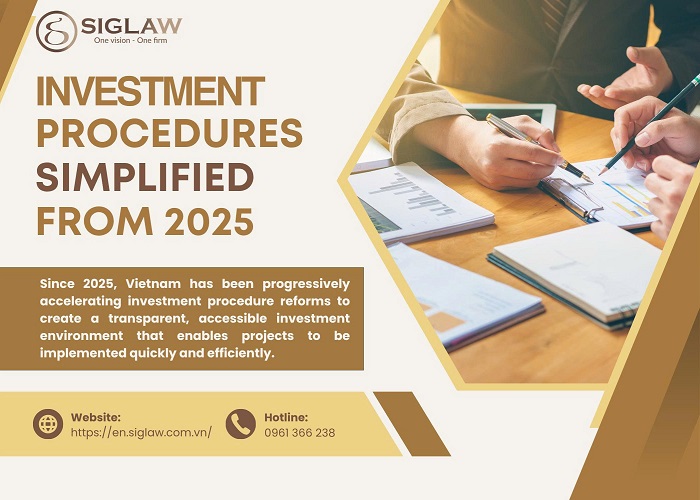
Accordingly, beginning in 2025, Vietnam has progressively accelerated investment procedure reforms aimed at streamlining administrative processes, advancing digitalization, and reducing unnecessary intermediary steps. However, the simplification of procedures should not be interpreted as a relaxation of regulatory oversight. In practice, while many procedures have been shortened in terms of processing time or administrative documentation, higher expectations are simultaneously being imposed regarding the accuracy of submitted dossiers and enterprises’ post-licensing legal compliance obligations.
As a result, investors should not merely focus on how procedures have become faster, but also seek to understand how these reforms may affect their long-term investment strategies in Vietnam. In the following article, Siglaw Firm provides an overview of the investment procedures that have been simplified since 2025 and the practical implications for investors.
Procedures for Establishing a Foreign-Invested Economic Organization
One of the most notable developments since 2025 has been the increasing simplification of procedures for establishing foreign-invested enterprises in Vietnam. Previously, investors seeking to implement investment projects were generally required to complete a relatively lengthy sequence of procedures, including preparing legal documentation and evidence of financial capacity, obtaining an Investment Registration Certificate (IRC), subsequently applying for an Enterprise Registration Certificate (ERC), and then fulfilling various post-establishment obligations such as business disclosure requirements, opening a direct investment capital account, registering digital signatures, or obtaining sector-specific sub-licenses for conditional business lines.
In practice, the separation between investment registration procedures and enterprise establishment procedures often resulted in prolonged market entry timelines, particularly where investors were required to supplement application dossiers multiple times or complete consular legalization procedures for documents issued abroad. For example, a Singaporean investor intending to establish a logistics enterprise in Hanoi may previously have spent several weeks revising documentation relating to business scope and market access conditions applicable to cross-border logistics services. In many cases, enterprises had already signed office lease agreements or recruited personnel but were nevertheless forced to postpone operational plans due to pending investment approvals.
Since 2025, reform efforts have increasingly focused on standardizing application templates, expanding electronic filing systems, reducing duplicative documentation requirements, and enhancing coordination between investment registration authorities and enterprise registration agencies in order to shorten actual processing times. These developments have enabled investors to commence operations more efficiently, particularly in sectors requiring rapid market entry, such as e-commerce, technology, and logistics.
Investment Policy Approval Procedures
In addition to enterprise establishment procedures, the investment policy approval process—traditionally regarded as one of the most time-consuming stages for large-scale investment projects—is also undergoing significant simplification from 2025 onward.
Previously, for projects subject to investment policy approval requirements, investors were generally required to complete a relatively complex multi-stage process, including: (i) preparation of an investment project proposal; (ii) demonstration of financial capacity and land-use demand; (iii) consultation with multiple competent authorities regarding planning, environmental, and construction matters; (iv) submission to competent authorities for approval; and (v) subsequent application for an Investment Registration Certificate (IRC). From a regulatory perspective, this framework enabled authorities to comprehensively assess project feasibility before granting approval, thereby reducing the risk of speculative investment registrations or poorly implemented projects.
In practice, however, the involvement of numerous intermediary procedures often caused businesses to miss commercial opportunities, particularly in fast-evolving sectors such as electronics, supporting industries, and renewable energy. In the context of rapidly shifting global supply chains, delays of several months caused by inter-agency consultation procedures may directly affect an enterprise’s ability to capitalize on market opportunities, adhere to investment schedules, and maintain project competitiveness.
Accordingly, beginning in 2025, Vietnam has increasingly moved toward greater decentralization to local authorities, enhanced inter-agency coordination mechanisms, and shorter investment dossier processing timelines. From a positive perspective, these reforms enable enterprises to respond to market opportunities more rapidly while significantly reducing waiting costs and administrative burdens.
On the other hand, shortened processing timelines also create greater pressure on investors to prepare high-quality application dossiers from the outset. Whereas enterprises previously had more time to supplement or revise documentation, under the new approach, project proposals lacking feasibility, or failing to provide sufficient explanations regarding technology, environmental impact, or land-use efficiency, may be subject to immediate requests for revision at an early stage. This demonstrates that procedural reform requires not only a shift in regulatory mindset but also a more professional and structured approach by enterprises in preparing legal documentation.
The reform of investment policy approval procedures reflects Vietnam’s broader effort to transition from an administrative control-oriented model toward an investment facilitation governance framework, consistent with the country’s objective of strengthening competitiveness in attracting capital amid ongoing global supply chain realignments. Nevertheless, the practical effectiveness of these reforms will largely depend on the degree of consistency among local authorities, the operational capacity of competent agencies, and the transparency of inter-agency coordination mechanisms.
Therefore, while reducing processing timelines remains an important objective, it is equally necessary to maintain an appropriate balance between facilitating investment and ensuring effective project quality control, thereby minimizing the risk of inefficient projects or developments that may adversely affect the environment and long-term planning objectives.
Procedures for Amending Investment Projects
Not only have market entry procedures undergone reform, but the process for amending investment projects—previously regarded as one of the most significant bottlenecks for foreign-invested enterprises (FDIs) during operational expansion—has also been increasingly streamlined since 2025.
In practice, foreign-invested enterprises rarely maintain their original investment plans unchanged after obtaining approval. Adjustments such as capital increases, expansion of production capacity, relocation of project sites, addition of business lines, or modification of investment objectives are common business needs aimed at responding to market fluctuations, evolving supply chains, and changes in global consumer demand.
Previously, investors seeking to amend investment projects were often required to undergo a relatively complex process, including the preparation of explanatory dossiers regarding proposed amendments, demonstration of financial, land-use, or technological feasibility, amendment of the Investment Registration Certificate (IRC), and revisions to enterprise registration details where changes involved charter capital, business lines, or ownership structure. In certain cases, enterprises were also required to obtain opinions from multiple specialized authorities where amendments involved planning, environmental compliance, construction matters, or land use.
This process created considerable obstacles, particularly in rapidly expanding sectors such as electronics, supporting industries, logistics, and high-tech energy. Where procedures became prolonged, enterprises risked missing opportunities to expand production, delaying participation in critical segments of global supply chains, or even relocating part of their operations to jurisdictions offering more flexible investment environments.
Against this backdrop, since 2025, reforms relating to investment project amendment procedures have increasingly focused on streamlining administrative processes, reducing intermediary steps, and strengthening inter-agency coordination mechanisms. Shorter processing timelines, reduced requirements for duplicative documentation, and enhanced cooperation between investment registration authorities and specialized agencies have enabled enterprises to adapt more efficiently to changing market conditions.
For foreign-invested enterprises, the ability to amend investment projects in a timely manner not only supports the optimization of business operations but also creates opportunities to capitalize on shifts in international supply chains, particularly amid intensifying global competition for investment attraction.
From a broader perspective, these reforms also contribute to enhancing the stability and predictability of Vietnam’s investment environment. When enterprises can adjust investment scale or strategic direction with greater flexibility and without excessive administrative burdens, Vietnam’s attractiveness as a destination for expansion projects or supply chain restructuring initiatives is likely to improve substantially.
Nevertheless, procedural simplification should not be interpreted as a reduction in regulatory oversight. Matters relating to environmental protection, technology standards, land use, and financial capacity remain subject to strict scrutiny to ensure that investment expansion proceeds in an efficient, sustainable manner and aligns with Vietnam’s long-term socio-economic development objectives.
What Should Foreign Investors Consider in Light of These Investment Procedure Reforms?
Viewed comprehensively, the investment procedure reforms introduced from 2025 onward reflect Vietnam’s transition from a “pre-control” investment management model toward an approach centered on investment facilitation coupled with enhanced compliance responsibility. Whereas enterprises previously faced multiple approval stages, substantial paperwork, and lengthy inter-agency coordination before commencing projects, Vietnam’s foreign investment procedures are increasingly being reshaped to become more transparent, more digitalized, and more time-efficient.
This development is particularly meaningful for enterprises seeking opportunities to establish foreign-invested companies in Vietnam amid rapidly evolving global supply chains. Rather than devoting excessive time to initial administrative procedures such as obtaining an Investment Registration Certificate (IRC), securing investment policy approval, or amending investment projects, businesses are increasingly able to commence operations more quickly, thereby improving market responsiveness and reducing entry costs.
Nevertheless, procedural reform also entails higher compliance expectations. As the regulatory framework progressively shifts toward an ex-post supervision model, responsibility for assessing market access conditions applicable to foreign investors, environmental compliance, land use, sector-specific licensing conditions, and investment reporting obligations increasingly rests with enterprises themselves rather than relying on prior regulatory scrutiny.
An enterprise may receive approvals more quickly, but may also face inspections, penalties, or project disruption if robust legal compliance systems are not established from the outset.
Accordingly, investment procedure reform since 2025 should not merely be understood as a matter of reducing paperwork or shortening processing timelines. Rather, it reflects a broader transformation in Vietnam’s investment governance philosophy: facilitating investment for high-quality investors while simultaneously requiring enterprises to become more professional, proactive, and compliance-oriented in legal risk management. This presents both significant opportunities for investors with long-term strategic visions and meaningful challenges for enterprises insufficiently prepared for heightened compliance expectations.
Conclusion
The simplification of investment procedures from 2025 onward represents not merely an administrative reform initiative but also reflects Vietnam’s broader commitment to building a more transparent, investor-friendly, and competitive investment environment amid ongoing global supply chain realignments. From streamlining procedures for establishing foreign-invested economic organizations, shortening investment policy approval procedures, simplifying investment project amendments, to accelerating digitalization and strengthening ex-post supervision mechanisms, these reforms are significantly reducing both market entry costs and project implementation timelines for businesses.
However, “simplified procedures” do not necessarily mean “lower legal risks.” On the contrary, as Vietnam gradually transitions from an ex-ante control model to an ex-post supervision framework, the importance of dossier accuracy, compliance with investment conditions, environmental and land-use requirements, and investment reporting obligations continues to increase. Accordingly, investors should not focus solely on obtaining approvals more quickly but must also devote sufficient attention to developing robust legal strategies and compliance systems to ensure the sustainable and stable operation of investment projects over the long term.
At a time when Vietnam’s investment environment is undergoing substantial transformation, a clear understanding of evolving investment procedures will enable enterprises to capitalize more effectively on market opportunities while minimizing legal and operational risks throughout project implementation. Drawing upon extensive experience advising numerous FDI enterprises, Siglaw Firm remains committed to supporting investors in reviewing legal conditions, structuring suitable investment models, and facilitating investment procedures in Vietnam in an efficient manner and in full compliance with applicable legal regulations.
Investors and enterprises seeking further information regarding investment procedures simplified from 2025, market access conditions for foreign investors, establishment of foreign-invested companies, investment project amendments, or assistance with investment procedures under the latest Vietnamese legal framework are welcome to contact Siglaw Firm for timely, effective, and tailored legal support from our team of lawyers and professional advisors.
Headquarters in Hanoi City: No. 44/A32 -– NV13, Area A Geleximco, Le Trong Tan Street, Tay Mo Ward, Hanoi City.
Branch in the South: No. 103 – 105, Nguyen Dinh Chieu Street, Xuan Hoa Ward, Ho Chi Minh.
Branch in the Central Region: VIFC DN – ICT Building Software Park No. 2, Nhu Nguyet Street, Hai Chau Ward, Da Nang City
Email: vp@siglaw.com.vn
Hotline: 0961 366 238
Facebook: https://www.facebook.com/hangluatSiglaw