At the high-level forum “VIFC Da Nang: Building Competitive Advantages Through Intangible Assets,” Dr. Lawyer Le Thi Dung – Founding Lawyer of Siglaw Firm – delivered sharp legal insights, identifying strategic bottlenecks and proposing breakthrough solutions for Vietnamese enterprises amid the upcoming wave of the International Financial Center (IFC).
Without Protecting Intangible Assets, Vietnamese Enterprises Will Forever Remain Hired Laborers on Their Own Intellectual Capital
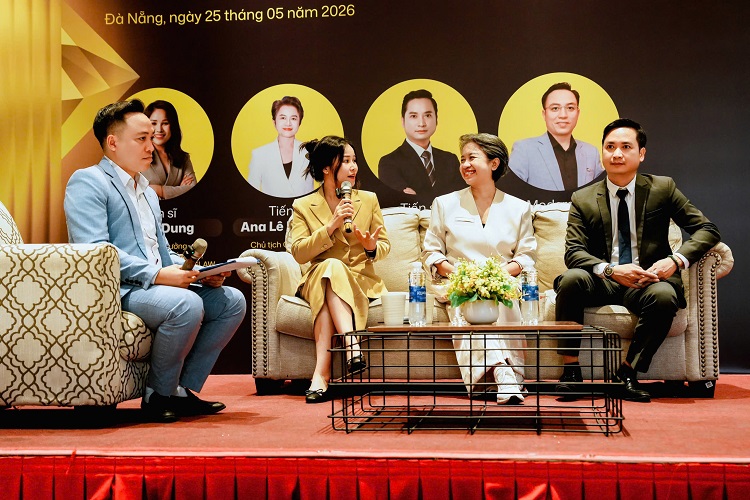
Opening the discussion session alongside Moderator Do Duy Hai Nam (CEO of Sofin Group) and fellow speakers Dr. Ana Le My Nga (Chairwoman of WeAngels Capital Investment Fund) and Dr. Nguyen Trung Kien (Director of the Institute of Technology Strategy and Innovation), Dr. Lawyer Le Thi Dung candidly pointed out that the greatest barrier facing enterprises does not come from external factors, but rather from “short-term thinking and a reactive legal mindset.”
“Many Vietnamese enterprises mistakenly believe that intellectual property (IP) protection simply means registering a trademark. They fail to realize that the greatest surplus value today comes from intangible assets such as trade secrets, exclusive operational processes, customer data, and the intellectual capital of R&D teams,” Ms. Dung stated.
Weak internal governance – particularly the absence of robust Non-Disclosure Agreements (NDAs) and Non-Compete Agreements (NCAs) with key personnel – is creating serious risks of information leakage and trade secret misappropriation. Many businesses are unintentionally turning themselves into free training grounds, allowing employees to bring core technologies to competitors without any legal means of protection.
Beyond internal barriers, the Director of Siglaw also provided profound analysis regarding the incompleteness of Vietnam’s institutional framework and technological proactiveness. In reality, prolonged examination periods for protection certificates, combined with administrative sanctions that lack sufficient deterrent effect, are inadvertently weakening the competitiveness of businesses in the digital era.
When questioned about the alignment between Sandbox mechanisms and the current legal framework, Dr. Lawyer Le Thi Dung stated frankly:
“They are not truly synchronized. Traditional risk-averse legislative thinking is fundamentally at odds with the very nature of Sandbox mechanisms, which are built upon the principle of controlled risk acceptance.”
In particular, regarding the vision of developing the Da Nang International Financial Center (VIFC), the female Doctor emphasized:
“We need an outstanding Sandbox mechanism approved by a Resolution of the National Assembly. This will become a magnet attracting global technology and financial corporations to bring their intellectual assets for investment, transforming Da Nang into a leading intangible asset protection hub in the region.”
It is evident that the heartfelt insights shared by Dr. Lawyer Le Thi Dung at the VIFC Da Nang High-Level Forum have opened an entirely new legislative and governance perspective on intangible assets. The journey toward helping Vietnamese enterprises break free from the position of a mere manufacturing and outsourcing nation, and instead rise to master global value chains, requires harmonious coordination at both institutional and corporate levels.
This means a transformation of the institutional framework toward a proactive role in fostering innovation through superior Sandbox mechanisms, while simultaneously driving a fundamental shift in executives’ perceptions of intellectual property rights. Establishing a rigorous internal governance structure, optimizing confidentiality measures, and proactively defining ownership rights are not merely legal compliance obligations; they are strategic investments to safeguard corporate cash flow and long-term survival value.
Only by deeply recognizing the value of intellectual capital and building a strong and secure legal foundation can Vietnamese enterprises confidently position their brands, unlock international capital flows, and firmly assert an independent standing in the global marketplace.