In today’s business environment, trading in goods is often regarded as an “easily accessible” industry. However, in practice, many enterprises encounter serious legal issues shortly after establishment and commencement of operations simply because they have not fully understood the regulations governing business permits.
Under current law, trading in goods does not always require only ordinary business registration. Certain categories of goods falling under the list of conditional business lines and professions (as prescribed in Appendix IV of the Law on Investment 2020, Revised and supplemented in 2025) require enterprises to obtain additional specialized permits before they may legally operate. Clearly distinguishing between ordinary goods and goods subject to conditional business lines is a critical factor in ensuring lawful operations and avoiding unnecessary legal risks.
What is a trading in goods business permit?
Under current legislation, there is no single general permit titled “Trading in Goods Business Permit” that applies to all types of goods. Instead, the right to conduct trading in goods is determined through two main categories of legal documents, depending on the nature of the goods being traded.
+) Enterprise Registration Certificate (ERC) under the Law on Enterprises 2020: This is the basic legal document confirming that the enterprise has been lawfully established. Once the Enterprise Registration Certificate is issued and the enterprise has registered the business line “Wholesale and retail trade in goods of all kinds” (industry codes under groups 46 and 47), the enterprise is fully qualified to conduct trading activities.
In this case, the law does not require any additional specialized permit.
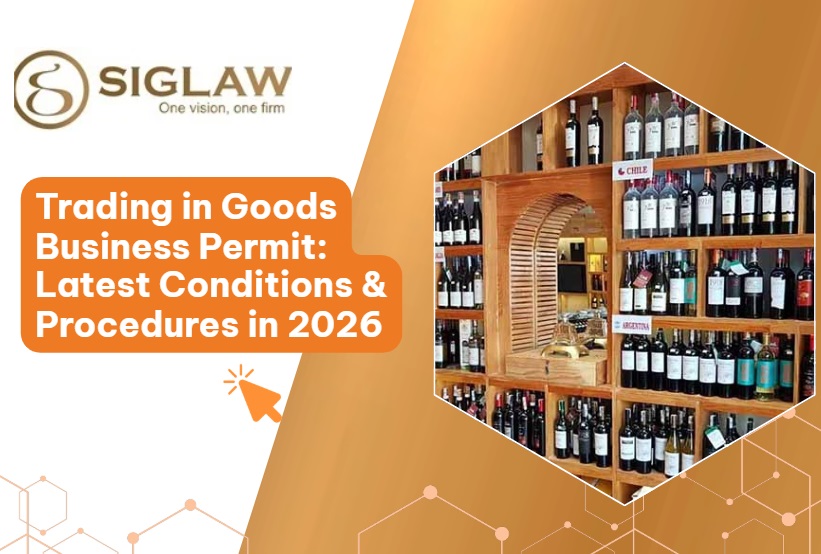
+) Specialized permit (for goods subject to conditional business lines): Certain categories of goods listed under the conditional business lines and professions in Appendix IV of the Law on Investment 2020 (Revised and supplemented in 2025) require enterprises to obtain a specialized permit issued by the competent state authority before they may legally conduct business. Common examples of such goods include: alcoholic beverages, beer, tobacco, pharmaceuticals, pharmaceutical raw materials, medical devices, petroleum, liquefied petroleum gas (LPG), and health supplements.
Operating in these categories without the corresponding specialized permit constitutes a legal violation. Pursuant to Decree No. 98/2020/ND-CP on administrative sanctions in the commercial sector, enterprises may be fined from tens of millions to hundreds of millions of Vietnamese dong, and may also be subject to remedial measures such as compulsory recall of goods, suspension of operations, or revocation of permits already granted.
Cases requiring specialized permits for trading in goods
Not all trading activities require a specialized permit. In practice, the law only mandates a separate permit for certain categories of goods falling under the list of conditional business lines and professions.
According to Appendix IV of the Law on Investment 2020 (Revised and supplemented in 2025) and current guiding documents, common categories of goods requiring specialized permits include:
+) First, goods directly affecting public safety and health, such as alcoholic beverages, beer, and tobacco. Enterprises wishing to trade in alcoholic beverages or beer must obtain a License for Trading in Alcoholic Beverages or Beer issued by the Ministry of Industry and Trade or the provincial Department of Industry and Trade pursuant to Decree No. 105/2017/ND-CP (as amended and supplemented). Similarly, trading in tobacco requires a Tobacco Trading License issued by the Ministry of Industry and Trade under Decree No. 67/2013/ND-CP (as amended and supplemented).
+) Second, goods related to health and medicine, such as pharmaceuticals, pharmaceutical raw materials, and medical devices. To trade in pharmaceuticals, enterprises must hold a Pharmaceutical Trading License issued by the Drug Administration of Vietnam – Ministry of Health under the Pharmacy Law 2016. For medical devices, depending on the classification group, enterprises may require an Import License or a Certificate of Free Sale under the Law on Medical Devices 2023. Conditions relating to storage warehouses, quality control systems, and personnel holding professional practice certificates in this field are generally very stringent.
+) Third, goods in the energy and minerals sector, such as petroleum and liquefied petroleum gas. Enterprises trading in petroleum must obtain a Petroleum Trading License issued by the Ministry of Industry and Trade under Decree No. 83/2014/ND-CP (as amended and supplemented). This type of business requires high standards regarding capital, storage facilities, transport vehicles, and fire prevention and fighting systems.
+) Fourth, other categories of goods subject to conditions, such as health supplements (functional foods), cosmetics, and hazardous chemicals. For health supplements, enterprises must complete product declaration procedures in accordance with the Law on Food Safety 2010 (as amended and supplemented) and Decree No. 15/2018/ND-CP before placing the goods on the market. Certain hazardous chemicals also require a separate business license under chemical regulations.
For ordinary goods not falling under the above categories, enterprises only need an Enterprise Registration Certificate with the appropriate trading business lines to be fully qualified to operate; no additional specialized permit is required.
Conditions for obtaining permits related to trading in goods
For the Enterprise Registration Certificate, enterprises need only satisfy the general conditions under the Law on Enterprises 2020 (Revised and supplemented in 2025).
Specifically, the enterprise must have a name, registered office address, clearly declared business lines, and a legal representative meeting statutory requirements. For ordinary trading in goods, current law does not prescribe minimum charter capital, warehouse area, or staff professional qualifications.
Enterprises need only correctly complete registration procedures at the Department of Finance in accordance with Decree No. 168/2025/ND-CP on Enterprise Registration to be eligible for the certificate.
For specialized permits, the conditions are significantly more complex and detailed, depending on the category of goods. For example:
- For trading in alcoholic beverages and beer, enterprises must meet conditions relating to warehouses, transport vehicles, distribution systems, and personnel holding professional certificates under Decree No. 105/2017/ND-CP (as amended and supplemented). In addition, enterprises must have suitable transport vehicles and commit to complying with food safety regulations.
- For trading in tobacco, conditions are prescribed in Decree No. 106/2017/ND-CP. Enterprises must have a distribution system and warehouses meeting prescribed standards and must commit not to sell products to persons under 18 years of age. Control of origin and fulfillment of tax obligations are also important factors considered by the licensing authority.
- For pharmaceuticals and pharmaceutical raw materials, conditions are stricter under the Pharmacy Law 2016 and guiding documents. Enterprises must have storage warehouses meeting GSP (Good Storage Practice) standards, a quality control system, and responsible technical personnel holding appropriate pharmaceutical practice certificates.
While registration for ordinary trading in goods only requires meeting basic conditions under the Law on Enterprises, categories of goods subject to conditions demand thorough preparation regarding physical infrastructure, personnel, and operational procedures.
Procedures and implementation process
(*) For ordinary goods:
+) Enterprises only need to carry out procedures for establishment and registration of business lines at the Department of Finance. These procedures are conducted in accordance with the Law on Enterprises 2020 and Decree No. 168/2025/ND-CP on Enterprise Registration.
+) When registering, enterprises must correctly declare the business line codes for trading in goods (generally under groups 46 and 47).
+) Upon issuance of the Enterprise Registration Certificate, the enterprise is fully qualified to commence trading activities immediately without any additional specialized permit.
(*) For goods subject to conditional business lines:
+) After obtaining the Enterprise Registration Certificate, the enterprise must prepare a dossier to apply for the corresponding specialized permit. The dossier typically includes an application for the permit, documents proving compliance with warehouse, transport vehicle, and qualified personnel requirements, and other relevant documents as prescribed for each specific business line.
+) The dossier is submitted to the competent specialized management authority. Depending on the type of goods, the receiving authority may be the Ministry of Industry and Trade, the provincial Department of Industry and Trade, the Ministry of Health, the Drug Administration of Vietnam, or other specialized agencies.
+) During appraisal, the state authority will conduct on-site inspection of the enterprise’s conditions (particularly warehouses and personnel). If the dossier is incomplete or fails to meet the requirements, the enterprise will receive a written request for supplementation or explanation.
In practice, many enterprises encounter difficulties at this stage primarily because they did not correctly identify the category of goods they intend to trade from the outset, resulting in repeated rejections of their dossiers or penalties after commencing operations.
Therefore, seeking advice from a specialized legal consultancy firm at the planning stage is essential to ensure the process proceeds smoothly and in full compliance with the law.
With a team of lawyers experienced in commercial and investment law, SIGLAW FIRM is committed to providing accurate, prompt, and cost-effective solutions for our clients.
For FREE CONSULTATION on procedures for trading in goods business, please contact:
Head Office in Hanoi: No. 44/A32 – NV13, Geleximco A Area, Le Trong Tan Street, Tay Mo Ward, Hanoi City.
Southern Branch: No. 103 – 105, Nguyen Dinh Chieu Street, Xuan Hoa Ward, Ho Chi Minh City.
Central Branch: VIFC DN – ICT Building, Software Park No. 2, Nhu Nguyet Street, Hai Chau Ward, Da Nang City.
Email: vp@siglaw.com.vn
Hotline: 0961 366 238
Facebook: https://www.facebook.com/hangluatSiglaw