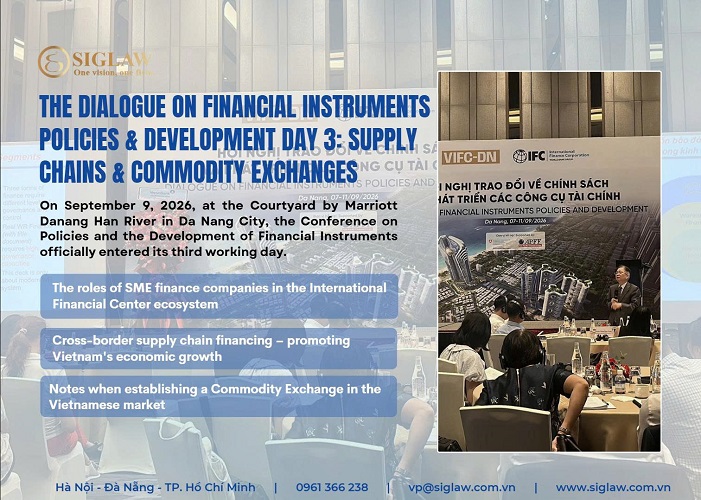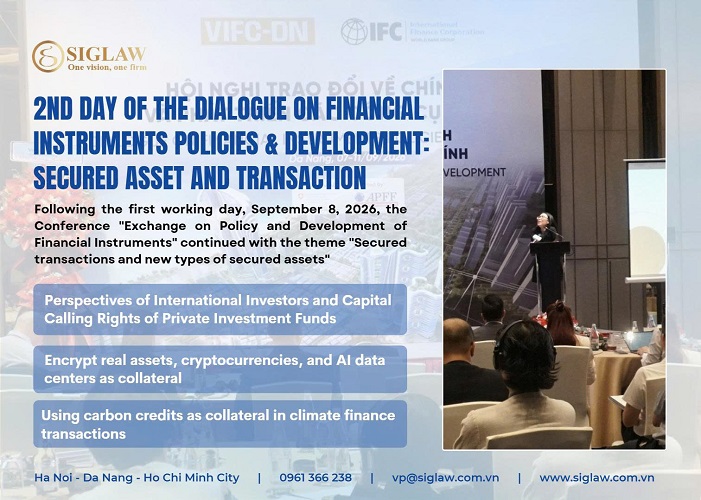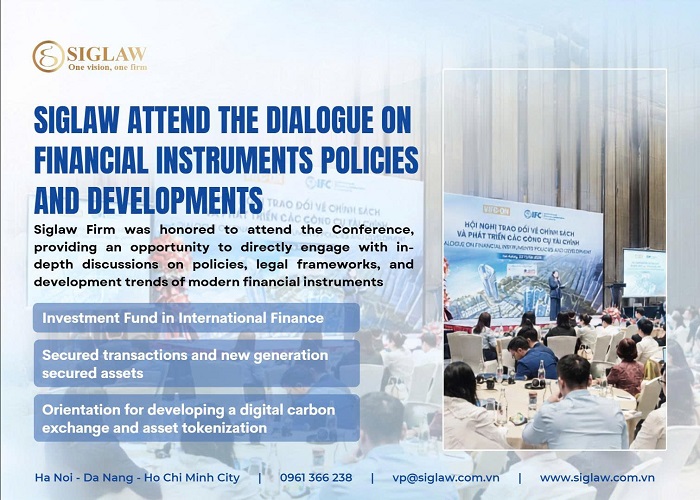
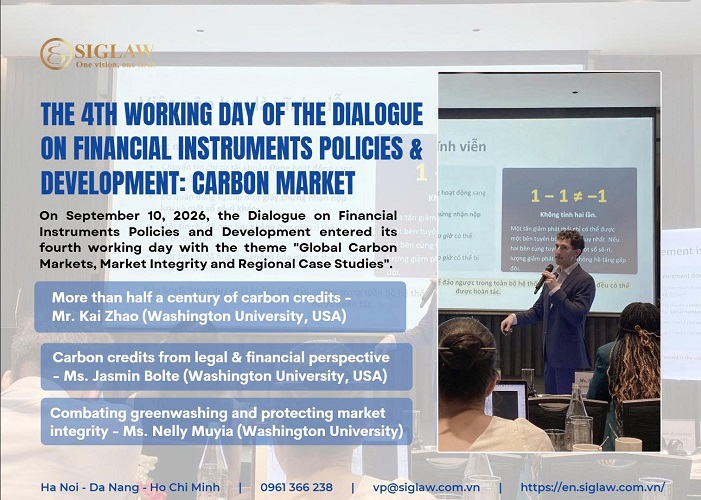
On September 10, 2026, at the Courtyard by Marriott Danang Han River hotel in Da Nang city, the Dialogue on Financial Instruments Policies and Development entered its fourth working day with the theme “Global Carbon Markets, Market Integrity and Regional Case Studies”.
Siglaw Firm is honored to continue accompanying the Dialogue on its fourth working day, thereby having the opportunity to directly hear in-depth discussions from leading experts on the international carbon market – one of the important pillars of green finance and global climate finance.
More than half a century of carbon credits
Opening the fourth working day was the presentation “Types of Carbon Credits and Global Carbon Market Models”, presented by Mr. Kai Zhao of the University of Washington (USA). The presentation looked back to the 1960 – 1990 period, when the concept of “pollution” was first recognized as a tradable asset, laying the initial legal and market foundations for what would later become the “carbon credit.”
Speaker Kai Zhao highlighted the important milestone of 1997, when the Kyoto Protocol was adopted and became the first international treaty to create carbon units that could be traded across borders. Alongside its achievements, the presentation also frankly pointed out three major challenges that the Kyoto Protocol’s mechanisms faced in practice:
- Demonstrating additionality (that a project genuinely could not have proceeded without the credits) has always been subjective;
- Certain credit types, such as those for HFC-23 destruction, inadvertently created perverse incentives favoring the continuation of emissions;
- In some countries, self-issuance of credits lacked the necessary independent oversight.
Drawing on the lessons of the Kyoto Protocol, Mr. Kai Zhao led into the 2015 Paris Agreement – the instrument that placed nations within a shared framework of objectives, with Article 6 paving the way for a new generation of carbon cooperation mechanisms. The presentation concluded by systematizing four foundational concepts that anyone approaching this field must clearly distinguish:
- Emission allowances (issued by the state);
- Carbon credits (representing one ton of emissions reduced or removed);
- Carbon offsetting (the act of retiring a credit so that it cannot be reused);
- Corporate carbon neutrality claims.
This conceptual framework would go on to underpin all of the day’s subsequent presentations.
Carbon credits from a legal and financial perspective
Continuing the Dialogue, Ms. Jasmin Bolte, also from the University of Washington (USA), presented the topic “Carbon Credits from Legal and Financial Perspectives: Assets, Commodities, Securities and Digital Assets.” This touches on one of the core questions that lawmakers around the world continue to debate: in legal terms, should carbon credits be classified as ordinary intangible property, as commodities tradable on an exchange, as securities governed by capital markets law, or as a new form of digital asset tied to tokenization technology.
The presentation analyzed how different legal classification models entail different consequences for ownership rights, disclosure obligations, transfer mechanisms, and the level of investor protection. Speaker Jasmin Bolte also pointed out that questions of carbon credit ownership often arise at various stages in a project’s life cycle – from formation, registration, and issuance through to trading on the market – and that designing a clear legal framework from the outset is the key to enabling carbon credits to achieve the necessary liquidity and attract long-term investment capital.
For Vietnam, this content serves as a direct reference point in building the legal framework for the domestic carbon market, as the choice of an appropriate legal classification model will largely determine how the market subsequently operates, how it is supervised, and how the rights of market participants are protected.
Combating greenwashing and protecting market integrity
One of the presentations that attracted particular attention during the morning was that of Ms. Nelly Muyia (University of Washington, USA) on “Preventing Greenwashing and Ensuring High Integrity throughout the Carbon Credit Lifecycle.” As more and more companies worldwide make climate commitments, the risk of greenwashing – exaggerating or misrepresenting the actual environmental contribution – is becoming a significant concern for investors, regulators, and consumers alike.
The presentation analyzed in depth the entire life cycle of a carbon credit, from project design, the development and approval of measurement standards, through to verification, issuance, and post-issuance monitoring once the credit enters circulation. On that basis, Ms. Nelly Muyia put forward a series of practical recommendations for strengthening market integrity, including enhancing the role of independent verification bodies, increasing transparency around calculation methodologies, and tightening post-issuance review mechanisms to promptly detect and address projects that fail to meet quality standards.
The operating structure of carbon trading markets
Closing the morning session before the lunch break, Mr. Diego Soto-Eisenberg (University of Washington, USA) spoke on “Carbon Market Trading Structures: Bilateral Carbon Contracts and Local, National and Global Exchanges.” The presentation analyzed the two principal forms of carbon trading markets today: the over-the-counter (OTC) market, where bilateral transactions are conducted directly between parties; and organized centralized exchanges, where carbon credits are listed and traded under standardized mechanisms.
The speaker introduced several leading trading platforms worldwide, such as Xpansiv and AirCarbon, while analyzing the advantages and disadvantages of each market model: whereas the OTC market offers a high degree of flexibility in contract negotiation, centralized exchanges have the advantage of price transparency and product standardization.
Another notable topic was the trend toward tokenizing carbon assets – digitizing carbon credits into units tradable on blockchain-based platforms – along with the legal framework requirements this trend gives rise to. This offers practical insights worth considering for the digital carbon exchange that Vietnam is researching and developing.
Vietnam’s legal regulations on carbon credits and recommendations for VIFC
After the lunch break, the Dialogue continued with a presentation by Mr. Nguyen Phuong Nam, Founder & CEO of KLINOVA Climate Innovation Consulting & Services, on “Vietnam’s Existing Regulation on Carbon Credits and Recommendations for VIFC.” This was the only presentation of the day delivered by a domestic expert, offering a practical perspective tied directly to the legal context and the development direction of Vietnam’s carbon market.
The presentation reviewed Vietnam’s current legal framework relating to carbon credits and the domestic carbon market, while putting forward specific recommendations for the Da Nang International Financial Center (VIFC-DN) in developing mechanisms and policies to attract and effectively operate carbon finance activities.
Experience from operating the California carbon market
Ms. Isabella Carreno, also from the University of Washington, brought a case study rich in practical value: the “Cap-and-Trade” program of the State of California (USA) – now renamed “Cap-and-Invest” and recently extended through 2045. This is one of the longest-standing compliance carbon markets, large in scale and regarded as among the most effectively operated in the world.
The presentation analyzed the program’s operating mechanism in detail: from setting an emissions cap that declines over time, to allocating free allowances calculated on the basis of emissions efficiency benchmarks, to the role of market oversight participants such as Monitoring Analytics and the Western Climate Initiative, along with the CITSS compliance tracking system. Notably, California has also established a market linkage mechanism with the province of Quebec (Canada) to share a common auction allowance pool, thereby improving operational efficiency and limiting the risk of market manipulation. Beyond the “cap” aspect of emissions, the program also emphasizes the “invest” aspect, as auction proceeds are reinvested into community-serving climate programs – a model balancing market discipline with social responsibility that many countries, including Vietnam, can draw upon.
Experience in developing carbon finance in China, India, South Korea, Southeast Asia, and Colombia
Another speaker from the University of Washington (USA), Ms. Betty Yu, delivered the presentation “Experiences from China, India, The Republic of Korea, Southeast Asia and Colombia in Developing and Operating Carbon Finance and Climate Finance Solutions.” The presentation opened by pointing out a core paradox in today’s voluntary carbon market: because host countries tend to prioritize retaining their most effective emission reduction efforts to serve national targets, the supply of new and credible carbon credits on the international market is becoming increasingly scarce and expensive.
From that paradox, speaker Betty Yu introduced market-building lessons from a range of countries: Colombia – a pioneer in nature-based projects, where market demand was created through tax policy, despite having gone through a contentious period before achieving firmer consensus; and South Korea – a high-emitting industrial economy that has turned its own decarbonization technology into a competitive advantage in the global voluntary market, while shifting its focus from emissions reduction to carbon removal.
In Southeast Asia, three stories were highlighted: Indonesia, with enormous credit potential estimated at around 13.4 billion tons of CO₂ equivalent, capable of contributing up to 60% of its national emissions mitigation target; Cambodia, with valuable lessons drawn from a flagship project that can save later entrants considerable learning costs; and Singapore – a country with limited domestic offset capacity that nonetheless rose to become a regional hub in under three years, thanks to a strategy of embedding demand and integrity directly into policy. Finally, India’s story shows that a country can become an important global provider of carbon removal services even before its domestic market has fully matured, provided it leverages its resource advantages appropriately and builds relationships with the right pioneering buyers.
Carbon finance and climate finance experience in China
Before the fourth working day drew to a close, Mr. Hiro Fu (University of Washington & Georgetown University Law Center, USA) shared with the Dialogue his insights on carbon finance and climate finance in China.
In his view, Mr. Hiro Fu argued that China is unlikely to regain the prominent position it once held in the international carbon credit market prior to 2012, owing to three structural changes: the increasing fragmentation of the global carbon market, China’s shift in focus toward developing its domestic carbon market, and persistent concerns regarding auditing and project governance.
Mr. Hiro Fu retraced China’s journey through specific milestones: in 2007, China formally institutionalized carbon finance with the establishment of the China Clean Development Mechanism Fund (China CDM Fund); by 2012, the country had achieved a dominant position in the international CDM market, with roughly 3,000 out of 5,500 projects globally. However, by 2017, China had to suspend the registration of CCER projects due to low trading volumes, supply-demand imbalances, and a lack of standardization in verification work. A major turning point came in 2021, when China officially launched its national emissions trading system (ETS), covering approximately 4.5 billion tons of CO₂ emissions annually and becoming the world’s largest ETS in terms of covered emissions.
The presentation also did not shy away from outstanding issues: 2024 saw a carbon credit fraud scandal in China worth billions of euros, leading to the early abolition of the UER credit issuance system; and in 2025, the international standards body Verra decided to withdraw a large number of projects in China following a broad review.
From China’s trajectory, speaker Hiro Fu distilled three major lessons for any country building a carbon market: the importance of transparent auditing and project governance, the need to adapt to volatility in international markets, and the decisive role of state management capacity in sustaining market confidence.
Closing the fourth working day
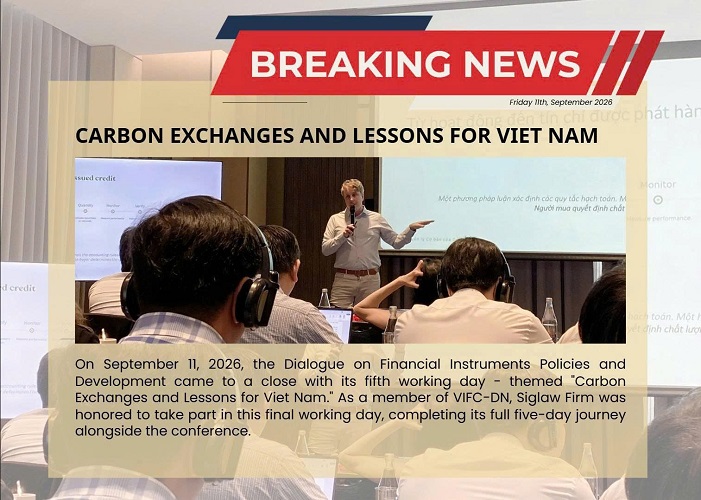
Throughout the fourth working day, the Dialogue presented a comprehensive picture of the global carbon market – from its historical and legal foundations, integrity assurance mechanisms, and the operating structure of exchanges, to a wealth of practical lessons from California, China, and numerous emerging markets across Asia and Latin America. The content shared not only reflects the maturity and the challenges of the international carbon market over more than five decades, but also opens up many practical insights for Vietnam as it researches and builds the legal framework and operational infrastructure for its domestic carbon market, in line with the development direction of the International Financial Center in Da Nang.
As a member of the Da Nang International Financial Center (VIFC-DN), Siglaw Firm continues to be honored to attend and accompany the discussion and professional networking activities within the framework of the “Dialogue on Financial Instruments Policies and Development.” Directly hearing in-depth insights from leading experts, scholars, and speakers on the international carbon market is a valuable opportunity for Siglaw to continuously update itself on the latest policy and legal trends, enriching its practical perspective in service of legal advisory work in the fields of investment, green finance, and sustainable development.
Trụ sở chính tại Tp. Hà Nội: Số 44/A32 – NV13, Khu A Geleximco, Đường Lê Trọng Tấn, Phường Tây Mỗ, Tp. Hà Nội.
Chi nhánh tại miền Nam: Số 103 – 105, Đường Nguyễn Đình Chiểu, Phường Xuân Hòa, Hồ Chí Minh.
Chi nhánh miền Trung: VIFC DN – Tòa nhà ICT Công viên Phần mềm số 2, Đường Như Nguyệt, Phường Hải Châu, Đà Nẵng
Email: vp@siglaw.com.vn
Hotline: 0961 366 238
Facebook: https://www.facebook.com/hangluatSiglaw