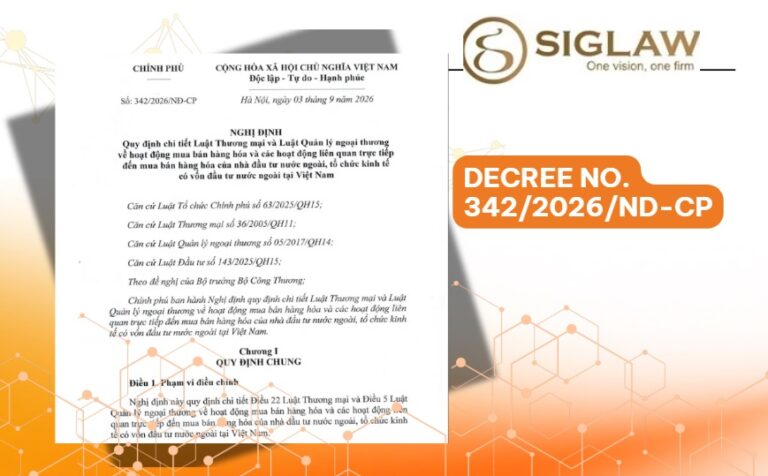
As of 18 October 2026, the retail activities of foreign investors and foreign-invested enterprises (FIEs) in Vietnam are governed by a new legal instrument: Decree No. 342/2026/ND-CP. The scope of the Economic Needs Test (ENT) has been narrowed, licensing procedures have been streamlined, while a security assessment mechanism for large retail chains and stricter reporting obligations have also been introduced.
This article by Siglaw Law Firm highlights the key new retail regulations that enterprises need to be aware of.
Overview of Decree No. 342/2026/ND-CP
On 3 September 2026, the Government promulgated Decree No. 342/2026/ND-CP detailing the implementation of the Law on Commerce and the Law on Foreign Trade Management with respect to the sale and purchase of goods and activities directly related thereto conducted by foreign investors and foreign-invested economic organizations in Vietnam. The Decree takes effect on 18 October 2026.
After more than eight years of implementation, Decree No. 342/2026/ND-CP completely replaces Decree No. 09/2018/ND-CP. The new Decree aims to reduce administrative procedures, accelerate digital transformation in licensing processes, strengthen post-licensing supervision, and enhance security assessments for large-scale goods trading business models in Vietnam.
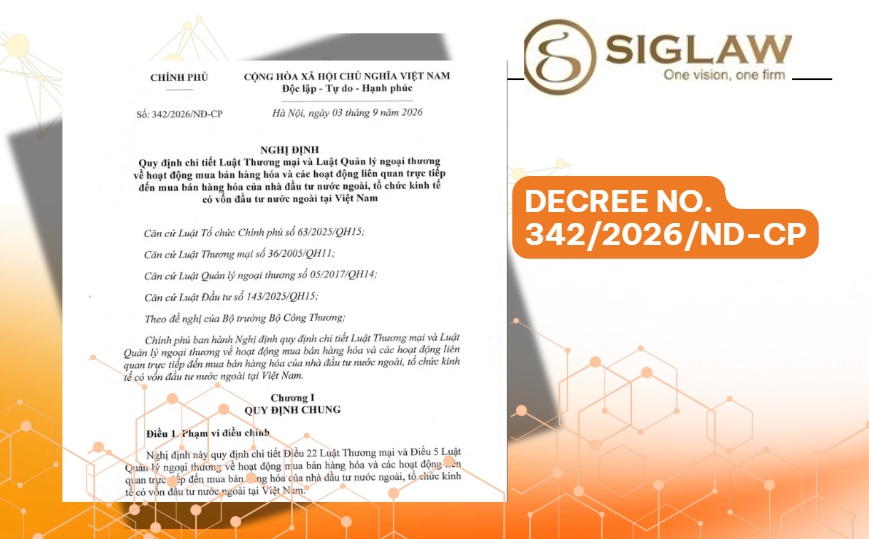
Decree No. 342/2026/ND-CP governs the following principal matters:
- The rights to export, import and distribute goods (including wholesale, retail, commercial agency and commercial franchising), as well as related commercial activities of foreign investors and foreign-invested economic organizations;
- The conditions, application dossiers and procedures for the issuance, amendment, re-issuance and revocation of Business Licenses;
- The conditions, application dossiers and procedures for the issuance, amendment, re-issuance, extension and revocation of Licenses for Establishment of Retail Outlets;
- The criteria for the Economic Needs Test (ENT), the operation of ENT Councils and cases exempt from the ENT;
- Reporting obligations, license revocation and transitional arrangements.
Competent Authorities and Procedures for Issuing Business Licenses for Goods Trading Activities
Competent licensing authorities under Article 8 of Decree No. 342/2026/ND-CP, Provincial-level People’s Committees are the licensing authorities, with their respective powers allocated as follows:
The provincial-level People’s Committee of the province where the foreign-invested economic organization has its head office: Responsible for the issuance, re-issuance, amendment and revocation of Business Licenses.
The provincial-level People’s Committee of the province where the retail outlet is located: Responsible for the issuance, re-issuance, amendment, extension and revocation of Licenses for Establishment of Retail Outlets.
Simplification of Procedures and Utilization of Electronic Data
Decree No. 342/2026/ND-CP introduces several notable new provisions concerning the procedures for obtaining Business Licenses for retail activities and Licenses for Establishment of Retail Outlets.
- Simultaneous submission of applications: An enterprise may simultaneously submit applications for a Business License and a License for Establishment of a Retail Outlet in respect of its first retail outlet, provided that such outlet is located in the same province or centrally governed city as its head office. This enables enterprises to shorten the time required to implement their business plans.
- Enhanced digitalization: Licensing authorities are to prioritize the retrieval of information from national databases and limit requests for enterprises to resubmit documents that are already available in the relevant systems.
- License validity: A Business License issued to an investor entitled to benefit from commitments under an applicable international treaty shall remain valid for the duration of the enterprise’s business registration. In all other cases, the Business License shall be valid for five years. The validity period of a License for Establishment of a Retail Outlet must be shorter than the remaining term of the investment project or the remaining lease term of the premises where the retail outlet is established.
Activities Requiring a Business License for Goods Trading Activities
| No. | Category of activity | Scope and applicable considerations |
| 1 | Retail distribution rights for goods | Applicable to ordinary goods, excluding special-category goods. A Business License must be obtained before commencing retail activities. |
| 2 | Importation and wholesale distribution of special-category goods | Includes petroleum-derived lubricants, rice, sugar, recorded audiovisual products, books, newspapers and magazines. |
| 3 | Retail distribution of special-category goods | Associated with a licensed retail outlet established in the form of a convenience store, mini-supermarket or supermarket. |
| 4 | Logistics services | Applicable to subsectors in which Vietnam has not undertaken market-opening commitments under international treaties. |
| 5 | Leasing of goods | Excludes financial leasing and the leasing of construction equipment together with its operator. |
| 6 | Trade promotion services | Includes sales promotion, commercial advertising, display and introduction of goods and services, trade fairs and exhibitions. |
| 7 | Commercial intermediary services | Includes brokerage, entrusted sale and purchase of goods, and goods auction services. Note: commercial agency activities fall under distribution rights and are no longer classified as commercial intermediary services. |
| 8 | Management and operation of e-commerce platforms | Includes intermediary e-commerce marketplaces, social networks conducting e-commerce activities, and integrated e-commerce platforms. |
| 9 | Services for organizing tenders for goods and services | Provision of tender-organizing services to other traders in accordance with commercial law. |
Economic Needs Test (ENT) for the Establishment of Retail Outlets
The ENT has long been a significant barrier for foreign retail investors seeking to expand their networks beyond their first retail outlet. With a view to promoting economic growth and attracting greater foreign investment, Decree No. 342/2026/ND-CP has narrowed the scope of application of the ENT.
The ENT applies only to investors from countries that have not made relevant commitments with Vietnam
Pursuant to Article 22, the ENT applies only to foreign investors from countries or territories that are not parties to an international treaty to which Vietnam is a party and under which Vietnam has undertaken to abolish the ENT, where such investors establish retail outlets other than their first retail outlet.
In other words, investors from countries or territories for which Vietnam has undertaken to abolish the ENT under free trade agreements to which Vietnam is a party are not required to undergo the ENT when opening their second or subsequent retail outlets.
The fact that an investor has obtained a license for its first retail outlet does not mean that it may freely establish additional retail outlets. The concept of a “retail outlet other than the first retail outlet” also includes an outlet established under the same brand or trade name as an existing licensed retail outlet.
Conditions for small retail outlets to be exempt from the ENT
For investors who remain subject to the ENT, a retail outlet other than the first outlet shall be exempt from the ENT if it satisfies all three of the following conditions:
(i) Its sales area is less than 500 m²;
(ii) It is established within a shopping mall;
(iii) It is not a convenience store, mini-supermarket or supermarket.
Market assessment scope and the ENT Council
Where the ENT is required, the geographical market to be assessed depends on the size of the retail outlet.
| Size of retail outlet | Geographical market scope | Assessment criteria |
| Less than 5,000 m² | Commune, ward or equivalent administrative unit where the outlet is located | – Impact on the market, retail outlets and traditional markets in the area;
– Market demand; traffic density; fire prevention and fighting; environmental sanitation; – Socio-economic contributions, including taxes and employment. |
| 5,000 m² or more | Province or centrally governed city where the outlet is located | – Impact across the entire province or centrally governed city;
– Impact on commercial network planning; – Impact on social welfare, traffic and public order and security. |
The ENT Council shall be established by the provincial-level People’s Committee and shall have 20 working days from the date of receipt of a complete and valid application dossier to conduct its assessment and issue its conclusion. The licensing authority shall thereafter consider issuing the License for Establishment of a Retail Outlet within the prescribed time limit.
Security Assessment and Premises Requirements
Consultation with the Ministry of Public Security and the Ministry of National Defence
In parallel with the relaxation of the ENT requirements, Decree No. 342/2026/ND-CP introduces a security consultation mechanism. The licensing authority is required to seek opinions from the Ministry of Public Security and the Ministry of National Defence in certain cases, notably:
- Investors from countries or territories that have not undertaken market-opening commitments in respect of special-category goods or related services;
- Foreign investors that exercise control over an enterprise operating a large-scale digital platform, including an intermediary e-commerce platform, a social network conducting e-commerce activities, or an integrated e-commerce platform;
- Investors that own or control a retail chain reaching any of the following thresholds: 100 outlets with a sales area of less than 500 m² each; 50 outlets with a sales area of 500 m² or more but less than 3,000 m² each; or 30 outlets with a sales area of 3,000 m² or more each.
For retailers planning rapid expansion, monitoring the total number and sales area of outlets within each threshold category should be incorporated into their expansion plans, as the application processing period may be extended where consultation is required.
Retail outlet premises must comply with sector-specific legislation
In addition to the ENT requirements, the premises where a retail outlet is established must comply with the laws and regulations on planning, land, investment, construction, fire prevention and fighting, traffic safety and environmental sanitation.
Retail M&A and Transitional Provisions
Vietnamese enterprises receiving foreign investment may continue operating for a maximum of 12 months while applying for licenses
Where a Vietnamese retail enterprise operating retail outlets receives capital contributions or shares from a foreign investor and thereby becomes a foreign-invested economic organization falling within the cases prescribed by law, the enterprise must carry out procedures to obtain a Business License for Goods Trading Activities and a License for Establishment of a Retail Outlet.
While the enterprise is carrying out the procedures for obtaining the aforementioned licenses, it may continue conducting retail activities at its existing operational outlets for a period not exceeding 12 months from the date specified in the document confirming that the foreign investor satisfies the conditions for capital contribution.
Applications for the Business License for Goods Trading Activities and the License for Establishment of a Retail Outlet must be submitted within 30 days from the date on which the foreign investor is confirmed to satisfy the conditions for capital contribution. The application must be accompanied by the latest year’s audited financial statements.
Licenses and applications existing before 18 October 2026
Business Licenses for Goods Trading Activities and Licenses for Establishment of Retail Outlets issued before the effective date of Decree No. 342/2026/ND-CP (18 October 2026) shall remain valid until the expiry dates specified therein. Enterprises are not required to replace such licenses. However, where any licensed information is changed, the relevant procedures must be carried out in accordance with the new Decree.
Licensing applications received by the licensing authority before 18 October 2026 shall continue to be processed in accordance with the former Decree, namely Decree No. 09/2018/ND-CP.
From Ex-Ante Control to Ex-Post Supervision: Periodic Reporting and License Revocation Risks
Reporting twice a year
Pursuant to Article 38, foreign-invested economic organizations falling within the scope of the Decree must submit periodic reports twice a year using the prescribed forms:
- First-half-year report: To be submitted before 15 July of each year.
- Annual report: To be submitted before 15 January of the following year.
In addition, the licensing authority may require an enterprise to submit a report at another time where necessary.
Cases in which licenses may be revoked
| Type of license | Grounds for revocation | Notes |
| Business License for Goods Trading Activities | – Cessation of the licensed business activities for more than 12 months without notifying the licensing authority;
– Repeated administrative penalties imposed consecutively within a 12-month period in respect of the licensed activities. |
An enterprise temporarily suspending its business activities should proactively submit a written notification before the 12-month period expires. |
| License for Establishment of a Retail Outlet | – The retail outlet ceases operations for more than 12 months without notifying the licensing authority (Point đ, Clause 2);
– Other cases prescribed under Article 42 of Decree No. 342/2026/ND-CP, including failure to satisfy licensing conditions and violations relating to the retail outlet. |
Revocation applies on an outlet-by-outlet basis. |
Recommendations for FIEs Operating in the Retail Sector
During the initial period of implementation of Decree No. 342/2026/ND-CP, FIEs engaged in the retail trading of goods should pay particular attention to the following matters:
- Review existing licenses: Compare the actual scope of business operations against the licensed scope; verify the validity periods of the Business License for Goods Trading Activities and the License for Establishment of a Retail Outlet; and identify any potential changes to licensed information.
- Determine ENT obligations before expansion: Identify the investor’s nationality, the applicable international treaties, and the type and sales area of each proposed retail outlet.
- Monitor retail chain size thresholds: Maintain statistics on the number of outlets within the three sales-area categories to anticipate the potential need for security consultation.
- Comply with post-licensing obligations: Keep track of reporting deadlines (15 July and 15 January), reporting procedures in the event of temporary suspension of operations, and measures to control the risk of administrative violations relating to licensed activities.
Decree No. 342/2026/ND-CP conveys two parallel developments: licensing procedures and the ENT have been adjusted to facilitate investment by investors from countries with relevant commitments, while the framework for post-licensing supervision, reporting and security assessment has been substantially strengthened.
For FIEs operating in the retail sector, proactive compliance and early legal planning will be decisive in enabling them to capitalize on the new provisions of the Decree.
If your FIE requires assistance with applications for a Business License for Goods Trading Activities or a License for Establishment of a Retail Outlet, the expansion of a retail chain, or M&A transactions in the retail sector, Siglaw Firm is ready to provide support and develop an appropriate legal roadmap.
Head Office in Hanoi: No. 44/A32 – NV13, Area A, Geleximco, Le Trong Tan Street, Tay Mo Ward, Hanoi.
Southern Branch: No. 103–105 Nguyen Dinh Chieu Street, Xuan Hoa Ward, Ho Chi Minh City.
Central Branch: VIFC DN – ICT Building, Software Park No. 2, Nhu Nguyet Street, Hai Chau Ward, Da Nang.
Hotline: 0961 366 238
Email: vp@siglaw.com.vn
Facebook: https://www.facebook.com/hangluatSiglaw