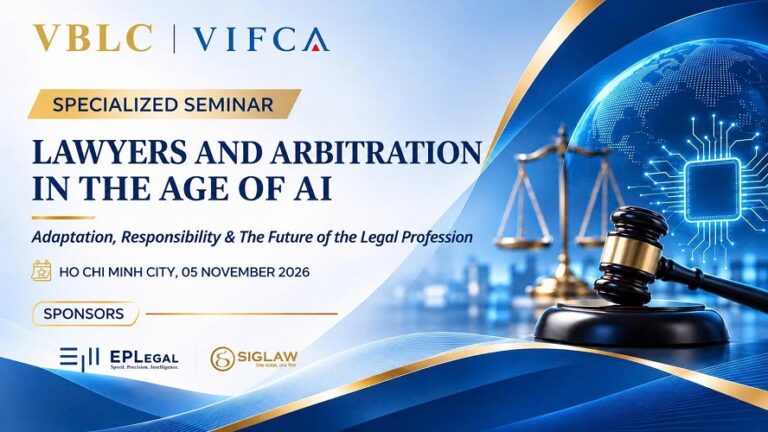
On 5 November 2026, a seminar entitled “Lawyers and Arbitration in the AI Era” was held in Ho Chi Minh City, jointly organized by the Vietnam Business Lawyers Club (VBLC) and the International Arbitration Centre under the International Financial Centre in Vietnam (VIFCA). The event provided a forum for professional discussion on the changes brought about by artificial intelligence (AI) in legal practice, investment advisory, international trade and dispute resolution.
The seminar featured two speakers: Dr. Lawyer Le Thi Dung, Founding Lawyer of Siglaw Law Firm LLC, and Dr. Lawyer Nguyen Trung Nam (Tony Nguyen), Founding Lawyer of EP Legal. Drawing on their extensive practical experience, the speakers offered in-depth perspectives on the evolving legal profession in the AI era, while highlighting ways to apply technology safely, effectively and responsibly.
Artificial Intelligence and the Future of the Legal Profession
In her presentation entitled “Artificial Intelligence and the Future of the Legal Profession: New Legal Challenges, Professional Responsibility, and the Transformation of Investment and International Trade Advisory Services,” Dr. Lawyer Le Thi Dung analyzed significant changes in the legal sector under the influence of AI, ranging from legal advisory activities and professional responsibility to the future development of legal services.
Artificial Intelligence Is Changing the Way Lawyers Practise
AI is increasingly being used in various legal tasks, including legal research, investment advisory, contract drafting and review, evidence compilation, preparation of arguments in disputes, and corporate legal compliance management.
However, as highlighted in the presentation, AI’s ability to process information does not equate to legal judgment. AI can compile large volumes of documents, identify contractual provisions, generate seemingly reasonable answers and assist with drafting more quickly. Nevertheless, determining whether legal grounds remain in force, assessing the commercial objectives of a transaction, anticipating how laws will be enforced and reaching conclusions appropriate to specific circumstances still require a lawyer’s professional expertise.
In this context, the value of lawyers is gradually shifting from merely providing information to their ability to verify information, exercise legal judgment and assume responsibility for their legal conclusions.
New Legal Challenges Arising from the Use of AI
The presentation also provided updates on developments in the legal frameworks governing AI and data in Vietnam and internationally. The use of AI in business activities may give rise to obligations relating to risk management, personal data protection, information transparency and the responsibilities of relevant stakeholders.
For FDI enterprises and businesses engaged in international trade, the use of AI systems may raise issues concerning cross-border data transfers, technology contracts, compliance with foreign laws and obligations within supply chains.
Dr. Lawyer Le Thi Dung presented practical scenarios to illustrate risks that may arise from the application of AI, including:
- Risks relating to legal grounds: AI may cite legal instruments that have expired, have not yet entered into force, or contain non-existent provisions, resulting in inaccuracies in legal advice;
- Risks arising from automated transactions: AI systems may automatically accept orders or transaction terms beyond what was intended, giving rise to disputes over contract validity, the scope of authority and the parties’ liabilities;
- Risks relating to information security: Uploading M&A files or clients’ internal documents to public AI platforms may lead to the disclosure of professional secrets, commercial information and personal data.
These scenarios demonstrate that the use of AI is not merely a technological issue. It also requires appropriate control procedures, approval mechanisms and clear professional accountability on the part of lawyers.
Opportunities for the Development of Legal Services in the AI Era
Alongside these challenges, AI also creates opportunities for the development of new legal service areas, such as AI compliance advisory, technology and data contracts, due diligence on AI systems in M&A transactions, liability relating to AI-powered products, and dispute resolution involving automated transactions.
Accordingly, law firms need to proactively redefine the value of their services, develop advisory products that meet emerging client needs, and consider fee models based on the scope, value and complexity of the work involved.
The central message of the presentation was that AI can help lawyers improve work efficiency, but it cannot fully replace their legal judgment, professional experience or responsibility.
Delegating Tasks to AI While Retaining Full Professional Responsibility
Building on the discussion of the future of the legal profession, Dr. Lawyer Nguyen Trung Nam (Tony Nguyen), Founding Lawyer of EP Legal, delivered a presentation entitled “Skills for Using AI Safely and Effectively in Legal Practice in Vietnam.”
With more than 25 years of experience in the energy, infrastructure, finance and dispute resolution sectors, the speaker shared practical insights into current categories of AI tools, their application in legal work, and the requirements for ensuring their safe and effective use.
Understanding the Capabilities and Limitations of AI
One of the topics addressed was the distinction between current AI and superintelligence (SI). While current AI can assist humans in performing specific categories of tasks but still requires supervision, superintelligence remains a hypothetical concept referring to a system whose capabilities would surpass human intelligence across multiple fields.
Distinguishing between these two concepts enables legal practitioners to adopt a more appropriate approach to technology: making use of AI capabilities that are already available in practice, while not automatically treating AI as an entity capable of assuming responsibility for its own actions.
The speaker also analyzed the categories of AI tools currently used in the legal profession, ranging from general-purpose AI assistants and legal AI tools to AI-integrated legal databases, AI embedded in office software, and AI agents.
Each category of tool has its own advantages and limitations. In particular, AI agents can independently carry out a series of operations, such as searching, reading, classifying documents and drafting. However, they may also pose greater risks if granted permission to perform actions without human approval mechanisms.
Applying AI in Transactions, Litigation and Arbitration
Drawing on his practical experience, Dr. Lawyer Nguyen Trung Nam shared approaches to applying AI in transaction advisory and dispute resolution.
In transactional work, AI can assist with reviewing contracts against checklists, comparing contract versions, extracting clauses during legal due diligence, bilingual translation and preparing negotiation strategies.
In litigation and arbitration, AI can assist with compiling case files, preparing timelines of events, identifying inconsistencies between witness statements and evidence, developing evidence matrices, and preparing the framework for written submissions.
However, the use of AI must be accompanied by appropriate verification procedures. The scenarios presented at the seminar demonstrated that AI may confuse dates, cite incorrect sources, generate non-existent judgments or provide unsupported assessments. Lawyers must therefore personally review original documents, verify legal grounds and assume responsibility for the content used in case files or delivered to clients.
Skills for Assigning Tasks to AI and Verifying Its Outputs
An important aspect of the presentation was the skill of formulating prompts when using AI. According to Dr. Lawyer Nguyen Trung Nam, an effective prompt should clearly specify the role, factual context, particular task, source materials, applicable law, relevant date and required output format. Clearly defined instructions help AI produce structured results that are easier to verify and better aligned with the objectives of the task.
In addition, the speaker emphasized a four-step process for verifying AI-generated outputs:
- Verify whether the cited legal instrument or information source actually exists.
- Check its legal status, including any amendments, supplements or replacement instruments.
- Compare the quoted content against the original text.
- Assess whether its application is appropriate to the relevant subject, time and legal relationship.
These steps are essential to minimizing errors when using AI in tasks that require a high degree of accuracy and professional responsibility.
Professional Ethics and Lawyers’ Responsibility When Using AI
One of the most important messages of the presentation was: “Lawyers may delegate tasks to AI, but they cannot delegate their professional responsibility.” The use of AI does not remove a lawyer’s obligations to maintain client confidentiality, meet professional competence requirements, ensure transparency in advisory activities or take responsibility for legal work products.
In particular, in arbitration and dispute resolution, the use of AI to process case files or prepare documents must be strictly controlled to avoid risks of disclosing litigation strategies, distorting evidence or relying on non-existent sources.
The speaker therefore emphasized the need for law firms to establish internal AI-use procedures, including access control, data management, identification of permitted tools, approval mechanisms and records of the verification process.
Adapting to AI for a Professional and Sustainable Future of the Legal Profession
The seminar “Lawyers and Arbitration in the AI Era” provided diverse perspectives on the transformation of the legal sector amid rapid technological development.
From identifying changes in legal advisory activities and updating participants on the legal frameworks governing AI and data, to practical skills for using AI in transactions, litigation and arbitration, the discussions helped clarify the need for legal practitioners to adapt to changes in the legal and business environment.
In particular, the seminar emphasized that technology can create real value only when used within a framework of responsible governance. The application of AI must be grounded in professional expertise, the ability to verify information, transparency and professional responsibility.
Siglaw Firm LLC would like to express its sincere appreciation to the Vietnam Business Lawyers Club (VBLC), the International Arbitration Centre under the International Financial Centre in Vietnam (VIFCA), EP Legal, the speakers and all participants for contributing to a meaningful professional exchange.
Siglaw will continue to support initiatives that connect knowledge, promote innovation and enhance professional expertise within Vietnam’s legal community, with the aim of fostering a professional, adaptive and sustainable legal practice in the AI era.
Head Office in Hanoi: No. 44/A32 – NV13, Area A, Geleximco, Le Trong Tan Street, Tay Mo Ward, Hanoi.
Southern Branch: No. 103–105 Nguyen Dinh Chieu Street, Xuan Hoa Ward, Ho Chi Minh City.
Central Branch: VIFC DN – ICT Building, Software Park No. 2, Nhu Nguyet Street, Hai Chau Ward, Da Nang.
Hotline: 0961 366 238
Email: vp@siglaw.com.vn
Facebook: https://www.facebook.com/hangluatSiglaw