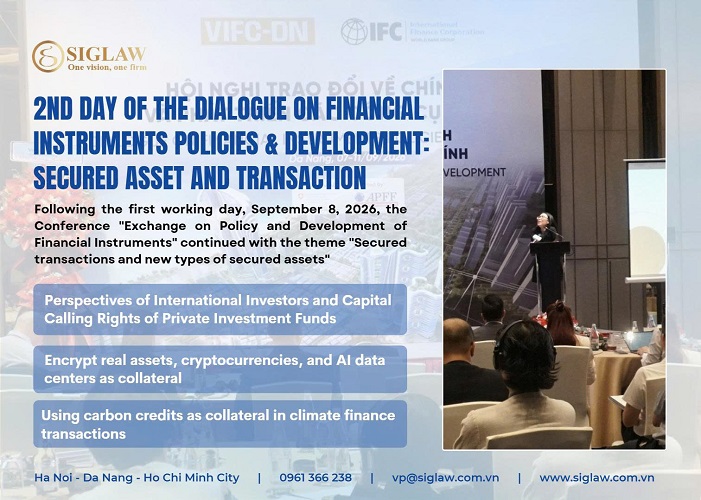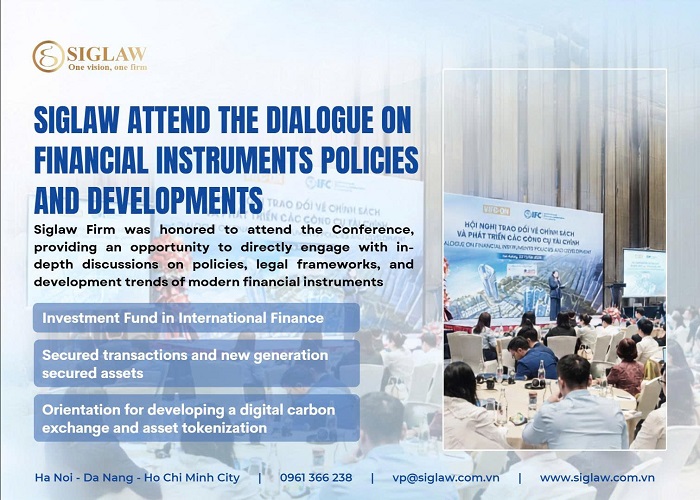
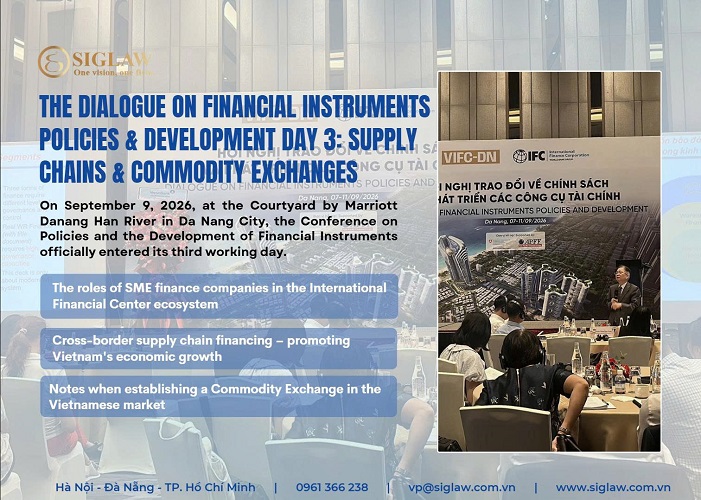
On September 9, 2026, at the Courtyard by Marriott Danang Han River in Da Nang City, the Conference on Policies and the Development of Financial Instruments officially entered its third working day. As a member of the International Financial Center in Da Nang (VIFC-DN), Siglaw Firm continued to participate in and accompany the Conference series, providing an opportunity to directly follow the latest policy and legal developments in the field of modern finance.
The third working day focused on the theme “Supply Chain Finance and Commodity Exchanges”, with discussions closely connected to practical production and business activities. The speakers examined how commodities, warehousing systems, and capital flows can be effectively connected, while highlighting the role of legal frameworks and modern financial technologies in improving the efficiency of supply chain financing and commodity transactions.
Asset-Based Finance – A Foundation for Modern Supply Chains
At the beginning of the program, Mr. Jinchang Lai, Head of Financial Infrastructure Development for the Asia-Pacific Region, Financial Institutions Advisory Group, IFC, delivered a presentation entitled “Introduction to Asset-Based Finance, Including Supply Chain Finance and Warehouse Finance.” Asset-based finance represents a substantial segment of corporate finance, accounting for approximately 60–75% of corporate lending globally and spanning a wide range of credit products, from receivables and revolving inventory to equipment and secured debt instruments.
In his presentation, Mr. Jinchang Lai addressed the current state of access to finance among small and medium-sized enterprises (SMEs) in Vietnam. According to data from a FiinGroup report, approximately 80% of Vietnamese SMEs — equivalent to nearly 730,000 out of more than 914,000 SMEs nationwide — currently remain outside the banking credit system, despite the fact that a significant proportion of these businesses have stable cash flows and relatively low levels of risk. This gap is primarily attributable to the lack of traditional collateral, particularly real estate, as well as a mismatch between the credit assessment practices of commercial banks and the operational characteristics of SMEs.
This financing gap creates room for new funding models. In this context, financial companies with diversified financing capabilities and the International Financial Center are expected to play a connecting role in bringing affordable capital from international institutions such as IFC closer to the domestic SME community in a manner that is faster, more flexible, and better aligned with actual financing needs.
The Role of SME Finance Companies within VIFC
Mr. Tong Nhat Linh, Deputy General Director of EVFinance Financial Company, continued the Conference with a presentation entitled “The Role of Finance Companies for SMEs within VIFC.” Similar to Mr. Jinchang Lai, Mr. Tong Nhat Linh highlighted a notable reality: approximately 80% of SMEs in Vietnam — nearly 730,000 out of more than 914,000 SMEs nationwide — remain outside the banking credit system, even though many of these enterprises maintain stable cash flows and relatively moderate risk levels.
Mr. Tong Nhat Linh identified four major barriers that make commercial banks cautious when serving this group of customers, including:
- Limited incentives to process small-scale loans, as the costs of credit assessment do not differ significantly from those associated with larger loans;
- A shortage of traditional collateral while SMEs are still in the process of improving financial transparency;
- Significant costs associated with transitioning operational models for credit institutions with relatively large and complex organizational structures; and
- Institutional constraints arising from increasingly stringent regulations protecting retail deposits, which have narrowed the scope for experimenting with non-traditional forms of collateral.
From EVFinance’s practical perspective, diversified finance companies, with lean organizational structures and without taking deposits from the public, may have greater capacity to serve as a “credit sandbox” for testing new financing models on a small scale before they are expanded. These companies can also serve as a bridge through which international capital flowing through VIFC can reach the domestic SME community more effectively.
Cross-Border Supply Chain Finance – Driving Vietnam’s Economic Growth
Next, Mr. Byron Pei, Founder and Chief Executive Officer (CEO) of Dowsure, presented the perspective of a financial technology company operating in cross-border supply chain finance through his presentation entitled “Cross-Border Supply Chain Finance – Driving the Growth of Vietnam’s Economy.”
Mr. Byron Pei examined supply chain finance against the backdrop of increasingly complex international trade flows. Vietnamese importers and exporters require more flexible working-capital solutions to keep pace with the movement of goods and cross-border payment cycles. Such solutions can, in turn, contribute to strengthening Vietnam’s position within regional and global supply chains.
From Commodity Finance to Warehouse Receipt Finance
Continuing the Conference, Professor Xuan-Thao Nguyen from the School of Law, University of Washington, Seattle, delivered a presentation entitled “From Commodity Finance to Warehouse Receipt Finance.” Her presentation examined the nature of warehouse receipts as a legal instrument that enables large quantities of standardized, durable, and readily storable commodities — such as agricultural products, industrial metals, and energy products — to be stored in licensed warehousing systems and subsequently used as eligible collateral for loans.
Professor Xuan-Thao Nguyen emphasized the critical role of licensed inspectors and weighing and measurement professionals in ensuring the reliability of the entire system. Their responsibilities range from sampling and grading commodities in accordance with international standards to verifying actual quantities in order to prevent fraud. These technical and legal foundations are essential for enabling banks and credit institutions to recognize warehouse receipts as genuine collateral, rather than merely as documents evidencing the storage of goods.
Connecting International Trade through Digital Technology
One of the most topical issues that attracted particular attention from participants on the third working day was the presentation by Mr. Nguyen Huu Vu Khoa, Secretary-General of the Global On-chain Economic Alliance (GOE Alliance) and a member of the Drafting Committee for the Commodity Derivatives Trading Law of the Ministry of Industry and Trade. His presentation addressed a supply chain financing model for the Vietnam–UAE trade corridor, the use of electronic warehouse receipts, and blockchain-based payment mechanisms.
The presentation demonstrated how digital technology can transform an underlying physical asset into data that can be tracked, verified, and traded transparently on a blockchain. This approach can shorten document-processing times, reduce the risk of fraud, and create new channels for raising capital for importers and exporters. It also provides a practical illustration of how digital transformation is increasingly becoming embedded throughout trade finance, while offering potential directions for Vietnam in developing digitalized trade corridors with international partners.
Beyond the technological dimension, Mr. Nguyen Huu Vu Khoa’s presentation also suggested a new approach to other bilateral trade corridors that Vietnam has established or may establish in the future. Rather than limiting cooperation to the conclusion of traditional trade agreements, developing a parallel digital infrastructure capable of verifying, tracing, and financing cross-border goods in real time could become a significant competitive advantage, particularly for agricultural products and raw materials, which have long been among Vietnam’s key export strengths.
Modern Warehouse Receipt Systems
Opening the afternoon session, Mr. Jinchang Lai continued with an in-depth presentation on modern warehouse receipt systems. The presentation examined the role of warehouse receipts in establishing rights over stored commodities, while also considering their potential use as an instrument to support businesses in accessing financing.
The presentation further focused on the relationship among commodities, warehouses, warehouse receipts, and the various participants in the supply chain. The standardization of warehousing procedures, commodity management, and warehouse receipt issuance was considered an important factor in ensuring that information concerning stored commodities can be verified and reliably used in financial transactions.
From a practical perspective, Mr. Lai’s analysis demonstrated how modern warehouse receipt systems can establish an additional mechanism for connecting real assets with financial markets, particularly in commodity-based financing.
Legal Framework for Warehouse Receipts and Commodity Derivatives
Following this, Professor Xuan-Thao Nguyen continued her presentation on the legal framework governing warehouse receipt systems, futures contracts, and commodity derivatives. The presentation focused on legal issues arising in the development and operation of commodity-linked financial instruments, including requirements concerning the establishment of rights, transactions, regulatory oversight, and mechanisms for safeguarding the interests of participating parties.
For warehouse receipt systems, a clear legal framework is essential to determine the legal validity of warehouse receipts, the rights of their holders, and the responsibilities of parties involved in the storage and management of commodities. At the same time, the development of futures contracts and commodity derivatives requires an appropriate regulatory framework covering trading mechanisms, settlement, risk management, and the protection of the rights and interests of market participants.
Towards a Commodity Exchange for Vietnam
The third working day concluded with two final presentations focusing on the development of a “Commodity Exchange.” Mr. Wenguang Zhao, a specialist in commodity futures exchanges from China, shared practical experience regarding the establishment and operation of a commodity futures exchange.
In his presentation, Mr. Wenguang Zhao provided an overview of, and then delved into, the roadmap for establishing a commodity futures exchange. Drawing on maps of major commodity futures exchanges around the world, he highlighted the strategic role that a commodity exchange can play in the development of a regional financial center. Examples included major exchanges such as CME Group and ICE in the United States, the London Metal Exchange in the United Kingdom, as well as exchanges in Shanghai, Singapore, and Hong Kong.
From a technological perspective, Mr. Wenguang Zhao recommended that new exchanges prioritize the use of market-tested platforms, such as CME Globex and Nasdaq INET, rather than developing their own systems from the ground up. This approach would facilitate faster implementation, enhance operational stability, and reduce operational risks.
The presentation clearly identified three concurrent roles that a commodity futures exchange must undertake, namely:
- A market operator;
- A frontline regulatory body responsible for monitoring transactions and sanctioning violations; and
- A central counterparty (CCP) responsible for managing settlement risks.
Key Considerations for Establishing a Commodity Exchange in Vietnam
At the final session of the third working day, Mr. Lamon Rutten, an IFC expert, highlighted important considerations for Vietnam in establishing its own commodity exchange. According to Mr. Rutten, a commodity exchange should not be viewed merely as a standalone financial product within the portfolio of an International Financial Center. Rather, it should be regarded as a foundational layer of market infrastructure supporting investment, financing, and trading across a broad range of other products.
In the context of Vietnam already having the Vietnam Commodity Exchange (MXV), which connects domestic market participants with global commodity prices, the opportunity for VIFC does not lie in replicating existing structures. Instead, it lies in developing new market infrastructure centered around the physical commodity flows of Vietnam and the wider region — covering contract design, physical delivery, standardization, warehousing, clearing and settlement, and the development of regional benchmark price indices. The question is therefore no longer whether Vietnam should establish a commodity exchange, but rather what infrastructure Vietnam should develop and how much of that ecosystem it should seek to control and operate in relation to the commodities it possesses.
Closing the Third Working Day
The third working day focused on “Supply Chain Finance and Commodity Exchanges,” covering a broad range of topics, from asset-based finance and warehouse receipt systems to the application of blockchain technology in trade finance and the development of a commodity exchange in Vietnam. The presentations approached these issues from legal, operational, and technological perspectives, providing a comprehensive view of the requirements and opportunities involved in building a modern financial ecosystem closely connected with real-world production and business activities.
As a member of the International Financial Center in Da Nang (VIFC-DN), Siglaw Firm highly values the opportunity to participate in discussions and stay updated on international experience in supply chain finance and commodity market development. The insights shared throughout the Conference have broadened Siglaw’s professional perspectives in the fields of finance, investment, and law, while also creating valuable opportunities to connect with experts, financial institutions, and business communities from Vietnam and abroad.
Head Office in Hanoi: No. 44/A32 – NV13, Area A, Geleximco, Le Trong Tan Street, Tay Mo Ward, Hanoi.
Southern Branch: No. 103–105 Nguyen Dinh Chieu Street, Xuan Hoa Ward, Ho Chi Minh City.
Central Branch: VIFC DN – ICT Building, Software Park No. 2, Nhu Nguyet Street, Hai Chau Ward, Da Nang.
Hotline: 0961 366 238
Email: vp@siglaw.com.vn
Facebook: https://www.facebook.com/hangluatSiglaw