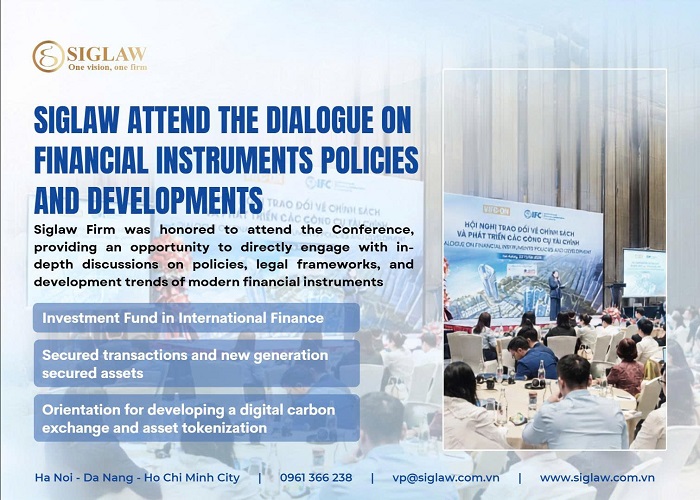
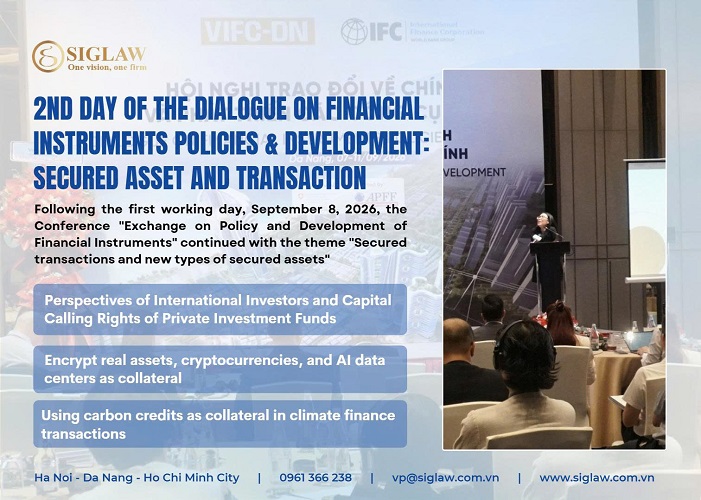
Following the topics discussed during the first working day, on September 8, 2026, the Conference on “Policy Discussions and Development of Financial Instruments” continued at Courtyard by Marriott Danang Han River Hotel, Da Nang City, under the theme “Secured Transactions and New Types of Collateral.”
While the first day focused on the investment fund ecosystem, fund models, and issues related to investment activities, the second working day shifted its focus to secured transactions and the development of types of assets that may be used to secure financial obligations. This is an important topic for the operation of capital markets, credit activities, and the ability of businesses and investors to access funding.
In addition to discussing the fundamental principles of secured transactions, the sessions also expanded into asset types that are increasingly emerging in modern financial structures, thereby raising new legal issues concerning the creation, management, valuation, and enforcement of rights over collateral in the context of rapidly changing technology and financial markets.
Overview of Secured Transactions
Opening the program, Professor Nguyen Xuan Thao – Professor of Law, University of Washington, United States, presented the topic “Overview of Secured Transactions.”
Secured transactions are one of the important mechanisms in financial activities, particularly in protecting the rights and interests of the financing party when financial obligations are not duly performed on time. Through collateral, the secured party has a basis to mitigate risks and enhance transaction security, while the obligor gains greater access to funding based on the value of the assets or property rights it owns.
From a legal perspective, secured transactions involve not only determining which assets may be used as collateral but also various issues such as the creation of security interests, priority rights, registration, control of assets, and mechanisms for realizing collateral when obligations are not performed. An effective security mechanism needs to optimize the secured party’s ability to enforce its rights while ensuring transparency and predictability for parties participating in the transaction.
The presentation also provided a foundation for approaching the in-depth issues discussed in subsequent sessions, particularly as collateral is no longer limited to traditional assets but is increasingly expanding to include property rights, digital assets, and technology-based assets. Addressing these issues from legal and international-practice perspectives helps clarify the need to establish a flexible secured transaction mechanism that is compatible with market developments while maintaining transparency, security, and enforceability.
An International Investor’s Perspective on Mandatory Collateral for Investment Projects
Continuing the program, Mr. Tran Anh Duc – Managing Lawyer, A&O Shearman, presented the topic “An International Investor’s Perspective on Mandatory Collateral for Investment Projects.”
For investment projects, particularly large-scale projects or those involving international investors, security mechanisms are among the factors considered in the risk assessment process. Clearly identifying the type of collateral, the scope of secured obligations, and the rights of the parties may directly affect the ability to raise capital as well as the attractiveness of a project to financial institutions and investors.
From an international investor’s perspective, collateral should be considered not only in terms of its economic value but also its ability to establish and enforce rights over the asset under the laws of the relevant jurisdiction. An asset with significant value may nevertheless increase legal risks and affect financing decisions if its registration, control, or enforcement mechanisms are unclear.
The presentation therefore highlighted the need to continue improving the secured transactions framework in a transparent, consistent manner that is compatible with cross-border transactions. This is also a factor that should be taken into consideration in developing an investment environment capable of attracting international capital flows.
Incorporating the perspective of international investors into the program helped broaden the discussion beyond purely legal considerations to address practical market requirements, thereby contributing to the identification of issues that should be considered when designing security mechanisms for future investment projects.
Secured Transactions and the Capital Call Rights of Private Investment Funds
Following the break, the program continued with the presentation titled “Secured Transactions and the Use of Private Investment Fund Capital Call Rights as Collateral,” delivered by Professor Nguyen Xuan Thao.
One notable aspect of the presentation was the consideration of capital call rights of private investment funds as a type of property right that may be used to secure financial obligations. Unlike traditional tangible assets, capital call rights arise from the relationship between a fund and investors who have committed to contribute capital. Therefore, using such rights in secured transactions gives rise to specific legal and practical requirements.
The inclusion of capital call rights in collateral structures demonstrates that the scope of secured transactions can extend beyond tangible assets to rights and economic interests arising from contractual relationships. This is highly significant for capital mobilization, particularly in investment structures where the value of assets primarily lies in future property rights.
However, for a property right to be effectively used as collateral, various factors must be considered, including the ability to identify the right, the scope of the obligor’s rights, the ability to transfer or control the right, and enforcement mechanisms where the secured obligation is not performed.
The presentation therefore addressed not only a specific type of collateral but also introduced a broader approach to property rights that have economic value but do not exist in the form of tangible assets. This is particularly noteworthy as modern investment structures increasingly rely on property rights and future cash flows.
Tokenized Real-World Assets and Cryptocurrency as Next-Generation Collateral
Opening the afternoon session, Professor Nguyen Xuan Thao continued with the presentation titled “Real-World Asset (RWA) Tokenization and Cryptocurrency as Next-Generation Collateral.”
The rapid development of blockchain technology and digital financial models is creating new methods for representing, managing, and trading asset value. In this context, Real-World Assets (RWAs) refer to the process of bringing real-world assets into the digital environment through tokenization mechanisms, while crypto assets are created and operated directly in the digital environment.
From the perspective of secured transactions, the emergence of these types of assets raises the question of whether rights over digital assets can be established, controlled, and enforced through mechanisms similar to those applicable to traditional assets, or whether new legal approaches are required.
Notable issues include identifying the party holding rights over the asset, the ability to control the asset, registration mechanisms, determining the priority among parties holding rights, and methods of realizing the asset when the secured obligation is not performed. For RWAs, the relationship between the underlying real-world asset and the tokenized asset is also an issue requiring consideration to ensure that rights over the digital asset accurately reflect rights over the underlying asset.
For crypto assets, their decentralized nature, ability to be transferred rapidly, and cross-border trading scope continue to create specific requirements for mechanisms governing the management and enforcement of rights.
GPUs and AI Data Centers as Collateral: A Case Study
Continuing the discussion on new types of collateral, Professor Nguyen Xuan Thao presented the topic “Graphics Processing Units and Artificial Intelligence Data Centers as Collateral: A Case Study of Nvidia’s AI Chip Products (H100, H200, Blackwell).”
The rapid development of artificial intelligence is driving substantial demand for GPUs, server systems, computing infrastructure, and data centers. These assets are increasingly important to technology companies and may simultaneously generate significant economic value.
The presentation used cases involving Nvidia’s H100, H200, and Blackwell product lines to analyze the potential use of technology assets as collateral. This is a noteworthy approach because high-tech assets have characteristics that differ significantly from real estate, machinery, and other traditional tangible assets.
One issue concerns the valuation and preservation of asset value in the context of rapidly changing technology. Short technology life cycles, the risk of obsolescence, and continuous changes in equipment performance may affect asset value throughout the term of a secured transaction. In addition, for AI data centers, determining the scope of assets used as collateral may involve various components, ranging from physical infrastructure, server systems, and computing equipment to related property rights.
Through the case study, the presentation demonstrated that secured transactions law needs to be capable of adapting to the emergence of high-value technology assets that change rapidly, thereby creating a basis for mobilizing capital to support the development of technology infrastructure and new economic sectors.
Using Carbon Credits as Collateral in Climate Finance Transactions
Concluding the day’s professional presentations, Professor Nguyen Xuan Thao presented the topic “Using Carbon Credits as Collateral in Climate Finance Transactions.”
As economies transition toward low-emission models, carbon credits are increasingly regarded as assets with economic value and the potential to participate in transactions in carbon markets. Considering carbon credits from the perspective of collateral therefore opens a new approach to raising capital for climate- and environment-related projects.
One important issue is determining rights over carbon credits, their transferability, value, and control mechanisms. These factors directly affect the ability to use carbon credits in financial structures. In addition, the characteristics of carbon credits, which are associated with specific standards, verification mechanisms, and trading markets, create specific requirements for the valuation and realization of such assets when the secured obligation is not performed.
Using carbon credits as a form of collateral is significant in the context of green finance and climate finance increasingly becoming important components of international financial markets. If supported by an appropriate legal framework, carbon-credit-related instruments could provide additional means of mobilizing resources for projects supporting the green transition and sustainable development.
The presentation also helped connect the topic of secured transactions with broader trends in modern financial markets, where objectives relating to green growth, emissions reduction, and energy transition are increasingly closely linked to investment and capital-raising activities.
Summary and Conclusion of the Second Working Day
The second working day of the Conference expanded the scope of discussion from the fundamental principles of secured transactions to the potential use of new types of assets in modern financial transactions. A notable feature of the program was the diversity of asset types discussed. In addition to traditional assets, capital call rights, RWAs, crypto assets, GPUs, AI data centers, and carbon credits all demonstrate potential to become new components of financial structures.
However, it is evident that the development of modern financial markets requires a legal framework that is flexible, adaptable to technology, and highly compatible with international practices. Particularly for new types of assets, clearly defining the rights of the parties and ensuring the practical enforceability of such rights are important factors in building confidence among investors and financial institutions.
These topics are of practical significance to the process of developing and establishing the International Financial Center in Da Nang (VIFC-DN), which aims to establish a financial ecosystem with international connectivity and the capacity to accommodate new financial models, products, and instruments.
As a member of VIFC-DN, Siglaw Firm was honored to participate in the Conference on “Policy Discussions and Development of Financial Instruments,” accompanying regulatory authorities, financial institutions, legal experts, and domestic and international organizations in professional discussions and research activities.
Through professional exchanges conducted within the framework of VIFC-DN, Siglaw Law Firm continues to seek to enhance its advisory capabilities in relation to international investment, finance, and business activities, while contributing to the development of a transparent, modern, secure legal environment aligned with international practices at the International Financial Center in Da Nang.
Head Office in Hanoi: No. 44/A32 – NV13, Area A, Geleximco, Le Trong Tan Street, Tay Mo Ward, Hanoi.
Southern Branch: No. 103–105 Nguyen Dinh Chieu Street, Xuan Hoa Ward, Ho Chi Minh City.
Central Branch: VIFC DN – ICT Building, Software Park No. 2, Nhu Nguyet Street, Hai Chau Ward, Da Nang.
Hotline: 0961 366 238
Email: vp@siglaw.com.vn
Facebook: https://www.facebook.com/hangluatSiglaw